Showing posts with label 1951. Show all posts

Wednesday, July 24, 2013

Manly Wade Wellman's "O Ugly Bird!" (short story, free): Hero frees a town of a curse

This is not science fiction; it's witchcraft. I loved it because of beautiful language - content didn't really matter!

Story summary.

Penniless hero is taking a long walk along a trail. On the way he sees & hears stories about the evil Mr Onselm & his Ugly Bird. Mr Onselm can hex anyone, & whole town is scared of him.

Of course, by the end of the story, hero will vanquish the villain.

Fact sheet.

First published: F&SF, December 1951.
Download full text from Baen Ebooks or Oregon Literary Review.
This is the first of the author's "Silver John" series.
Rating: A.

Monday, January 28, 2013

"Astounding Science Fiction" (British Edition), June 1951 (magazine, free): Annotated table of contents & review

Cover of Astounding Science Fiction magazine, British edition, June 1951 issue.
Links on author fetch more matching fiction by author. Where I have a separate post on a story, link on story title goes there. For read stories, my rating appears in brackets. Where I'm aware of alternate availability of a story on the web, I include those links too.

Table of contents (best first, unread last).

  1. [novelette] Poul Anderson's "The Helping Hand" (A); read online: International "aid" considered harmful...
  2. [ss] Jack Vance's "The Potters of Firsk" (A); download radio adaptation: Hero peacefully frees a tribe from oppression by its ferocious neighbors.
  3. [ss] Miles M Acheson's "The Apprentice" (B): Adventure on Venus...

Fact sheet.

Labeled: "VII, No 10 (British Edition)".
Download scans as a CBR file. [via Bob@pulpscans]
Note: Link points to a RAR file that contains target CBR, probably to work around some hosting service file naming constraints.
Related: Stories from the Astounding/Analog issues edited by John Campbell, old "pulps", 1950s.

Thursday, September 27, 2012

Fredric Brown & Mack Reynolds' "The Switcheroo" (short story, body snatching, humor, free)

Illustration by Bill Terry accompanying the original publication in Other Worlds Science Stories magazine of the short story The Switcheroo by Fredric Brown and Mack Reynolds. Picture shows a man with a gadget that lets you switch consciousness with another person's body.
Title refers to a gadget. Inventor's "pet name for it, of course. Actually it is a psychoreversamentatron." It helps you snatch bodies. You point it at yourself, think hard of someone, & flick a switch. And your consciousness moves into the body of the person you were thinking of, & his consciousness moves into the body you have. Other person need not be close to you at the time of using the gadget.

Inventor of the gadget & a press reporter privy to its secret both want to get rid of someone - inventor of his nagging wife, reporter of his unbearable boss. And then there are the desirable bodies of the state governor & of the President (both of US). Some fun the duo will have switching bodies.

Fact sheet.

First published: Other Worlds, March 1951.
Download full text as part of the scans of the magazine it originally appeared in.
Rating: B.
Related: Stories of Fredric Brown, Mack Reynolds.

Tuesday, September 18, 2012

Eric Frank Russell's "Test Piece" (short story, first contact, free): Don't say it. Or die!

Illustration, by Bill Terry, accompanying the original publication in Other Worlds Science Stories magazine of short story Test Piece by Eric Frank Russell
This is a contest story - great anticipation buildup, & a positive conclusion, but key to conclusion is for the reader to find! I wonder how it would look like in a reprint, without contest details of the original publication.

Story summary.

A human ship with 3 crew members has just landed on the alien world of Shaksembender - a followup to the world's discovery message from a scout 300 years ago. A world with hominids who now revere that long forgotten scout as a god. A god who'd asked them to be wary of the coming of men - it will either spell their doom, or will lead to salvation.

And he gave them a test to give to the future human landing party - when put in a certain situation, if the visitors utter two specific words in a sentence, that means doom & they must be immediately destroyed. What are those words? That's for reader to guess.
PS: Rob Slaven thinks the two words are likely to be racially derogatory to blacks of US in 1950s, & that the story is essentially an anti-racism piece.

The crew will meet a reception committee & will successfully pass the test.

Fact sheet.

First published: Other Worlds, March 1951.
Download full text as part of the scans of the magazine it originally appeared in.
Rating: B.
Related: Stories of Eric Frank Russell (annotated list).

Saturday, September 15, 2012

"Other Worlds Science Stories", March 1951 (ed Raymond A Palmer) (magazine, free): Annotated table of contents

Cover, by H W McCauley, of Other Worlds Science Stories magazine, March 1951 issue
Links on author fetch more fiction by author. Where I have a separate post on a story, link on story title goes there. My rating for read stories is in brackets.

Table of contents (best first, unread last).

  1. [ss] Eric Frank Russell's "Test Piece" (B): Don't say it, or your life is forfeit!
  2. [novelette] Theodore H Sturgeon's "Last Laugh": "There was nothing so terrible as the Gabblers. Human ears could not withstand their horrid uproar--& death to all comers glared from their eyes."
  3. [ss] Lou Tobakow's "The Wedding Present": "Only the god-color's golden glory could be a fitting gift--& Vroom found just the thing for the wedding present".
  4. [ss] David H Keller's "The Plot Machine": "Here's advice to those of you who want to write science fiction--"
  5. [novelette] Ray Palmer's "Eye of the Temptress": "Beginning with Eve, each period of our history has been influenced by a beautiful woman. But have you ever stopped to wonder why? Take, for instance, our present day temptress..."
  6. [novelette] Charles R Tanner's "Angus MacAuliffe & the Gowden Tooch": 'Angus received a legecy from his warlock uncle, but it wasn't what it seemed--for it contained a Greek, & what was worse, he was a Greek who came bearing "gifts."'
  7. [ss] Fredric Brown & Mack Reynolds' "The Switcheroo": "The switcheroo did a wonderful thing--it sent you into the body you were thinking of at the time."
  8. [novelette] William C Bailey's "The Solution": "When young Pinky Lane returned to Castor, he was considered fair game by everyone at the Casino. Pinky, however, had learned his lesson the first time & now had a few plans of his own."
  9. [ss] Charles E Fritsch's "The Wallpaper": "He came out of the wallpaper, intent on seduction--as was Pan's usual practice, but..."

Fact sheet.

Download scans as a CBR file. [via Rog@pulpscans]
Related: Fiction from Other Worlds, old pulps, 1950s.

Monday, August 27, 2012

H B Fyfe's "Protected Species" (short story, first contact): Arrogant humans are humbled

It's not always logical, particularly the successful human harassment of local "ape men", but it has a beautiful ending.

Story summary.

Arrogant humans have arrived on a new world to colonize. A world with ancient ruins of some intelligent species no longer around. A world humans are in a hurry to civilize. They'll be humbled by the end of the story.

Collected in.

  1. John W Campbell, Jr (ed)'s "The Astounding Science Fiction Anthology".

Fact sheet.

First published: Astounding, March 1951.
Among the stories from John Campbell's Astounding/Analog.
Rating: A.
Related: Stories of H B Fyfe.

Sunday, August 26, 2012

Murray Leinster's "Historical Note" (short story, satire, free): What if personal flyers became a reality?

I have a feeling I've read this before, though I didn't remember the details.

It's both a lampooning of communist Soviet Union & a science fictional "what if" on small personal flyers. Indian readers should find some of the idiocy of the lampooning parts familiar.

Collected in.

  1. John W Campbell, Jr (ed)'s "The Astounding Science Fiction Anthology".

See also.

  1. Clifford D Simak's "City" (novelette, 1944): Leinster's version also deals with the central idea (how suburbs will be remade if personal fliers became widely owned) of this widely loved story, but only in a passing way.

Fact sheet.

First published: Astounding, February 1951.
Read online at Docin.
Among the stories from John Campbell's Astounding/Analog.
Rating: A.
Related: Stories of Murray Leinster.

Saturday, February 18, 2012

Robert Heinlein's "The Puppet Masters" (novel, alien invasion): Parasitic aliens are taking over humanity

Cover image of the novel The Puppet Masters by Robert Heinlein. Image shows a man literally attached to strings, as if he is a puppet.
I wonder if the story is primarily a criticism of the Soviet communism. Author makes several uncharitable remarks on the subject, which make me suspect.

It's very readable, though. Action packed, hard to put down.

Note that there are at least 3 versions of this story:
  1. Original (long version) that was printed for the first time in early 1990s. This post is based on this version.
  2. A shortened novel version that was published sometime in 1950s.
  3. A serialized version of this shortened version, that appeared in Galaxy after extensive editing by its editor, H L Gold.

Story summary.

Think brainwashing parasites. If you are infected, you are aware of your identity, but your body does parasite's bidding.

Parasites are intelligent alien invaders from Titan, with amoeba-like flexible body. Their preferred method of infecting a human host is by extending a tendril to any part of victim's body to paralyze the host; eventually attaching themselves to the upper half of the spinal cord of victim in the form of a shaft a couple of inches thick & half the spine long (& hidden underneath the shirt). They can multiply very fast where there is opportunity. They prefer infecting humans, because that's the path to ruling earth. But when needed, they can infect all sorts of animals too.

At a place in the story, it is surmised that they probably are a single huge organism with common memory. And the individual parasites have some sort of urge to sync their memories often - by physically attaching to each other. How they evolved like this is not explained; I would think the tendency to spread an infection through most population quickly by frequent physical contact would have rooted it out by evolution long ago. In fact, that's the way they're eventually defeated; an engineered virus artificially introduced into infected human population that kills parasites far faster then their hosts - so hosts can get treatment.

Story is of a small team of a super-secret US government agency discovering the infection & helping fight it.

Fact sheet.

First published: Galaxy, September/October/November 1951.
Rating: A.
Related: Stories of Robert Heinlein.

Tuesday, October 25, 2011

John Wyndham's "The Day of the Triffids" (novel, post-apocalypse survival, free?)

Cover image of the 1951 novel The Day of the Triffids by John Wyndham
While post-apocalypse survival is not my favorite genre, I liked it a lot - probably because it makes mostly a light reading. Even gory scenes are presented in a way that mostly makes light reading.

Story summary.

One fine day, whole world goes blind - barring a very few that had to remain indoors, not watching a magical celestial spectacle that lasted over a day. Since human civilization depends on sight more than anything else, this is an apocalypse event.

Survival is made even more complex because of "triffids" - carnivorous intelligent plants capable of walking, talking among themselves vocally, & strategizing! These have been grown consciously often in large farms because of their highly desirable "oil". Vanishing of humans has freed them; so they're now hunters of hapless humanity!

Story follows William Masen, the narrator, a triffids expert, who was in hospital with eyes bandaged & so survived blinding.

Notes.

  1. No definite cause of celestial spectacle or origin of triffids is provided, but we're given some speculation: that both were of Soviet military origin, that triffids spread across the world when soviets drowned a spy plane that was smuggling triffids seeds to West, & that celestial event was a Soviet satellite weapon that misfired.
  2. Triffids are supposed to have three stumps for legs. In a scene, they kill a little girl & a triffid is seen walking in her shoes. How come the shoes don't fall off since triffids don't have a foot like appendages? Or do they have them?

Fact sheet.

First published: 1951.
Someone seems to have put a copy online. I'm not sure it's legitimate, but the novel is from early 1050s - so may be.
Rating: A.

Saturday, July 16, 2011

"Galaxy Science Fiction", Vol 3 No 2 (November 1951) (ed H L Gold) (magazine, free): Annotated table of contents

Cover image of Galaxy Science Fiction magazine, November 1951 issue.Scans of this magazine in CBR format are online as part of a larger package.

Table of Contents.

Links on author fetch more fiction by author.
  1. [novelet] Frank Quattrocchi's "Sea Legs": "Rootless & footloose, a man in space can't help but dream of coming home. But something nobody should do is be on the validity of a homesick dream!"
  2. [novelet] Bernard Wolfe's "Self Portrait": "In the credo of this inspiringly selfless cyberneticist, nothing was too good for his colleagues in science. Much too good for them."
  3. Alan E Nourse's "Tiger by the Tail": Where do objects go when they vanish & can never be found again? Well, here's one answer you can't disprove!"
  4. Ann Griffith's "Zeritsky's Law": "Why bother building a time machine when there's something much easier to find right in your own kitchen?"
  5. Lloyd Williams' "Psychotennis, Anyone?": "If scientific advance changes our forms of courtship, can other sports be far behind? Not when telekinesis is finally perfected!"
  6. [novel serial - part 3/3] Robert A Heinlein's "The Puppet Masters": "Beaten in every battle with the ghastly invaders, man has one single weapon left - his mind! But will that prove enough?"

Related.

  1. Fiction from Galaxy.
  2. "Pulp" magazines.
  3. Works of H L Gold.
  4. Fiction from 1950s.

Tuesday, December 28, 2010

Benson Dolling's "Amber Insect" (short story, monster, free): Missing link between "Who Goes There?" & "Jurassic Park"?

Now we know a key idea in Michael Crichton's "Jurassic Park" wasn't really original - putting into our world the monsters hidden in fossilized insect trapped in amber.

I also got a feeling of John Campbell's "Who Goes There?" (download): the curious men waking up a sleeping monster that will then unleash a nightmare.

Overall, however, this story is far less interesting than both "Who Goes There?" & "Jurassic Park".

Story summary.

Unnamed South American neighbor from the apartment above has called Mr Mentor to his apartment to be witness to an unusual event: freeing of a long fossilized insect that clearly seems alive from a piece of amber purchased years ago!

Nightmare will be unleashed when the insect is freed...

Fact sheet.

First published: Cavalcade, August 1951.
Download full text as part of the scans of the magazine it originally appeared in.
Rating: B.

Tuesday, December 7, 2010

Free fiction: 2 issues of "Worlds Beyond"

Scans of both in CBR format at Crosseyed Cyclops.

In bold below are the link names used in the linked post (which doesn't use useful issue names in its links).

If I have a separate post on an issue, link on issue name goes there. Links on authors fetch more of their fiction.

  1. "V1 #2 download": January 1951. Among the authors: Judith Merril, Rudyard Kipling, William Tenn.
  2. "V1 #3 download": February 1951. Among the authors: Jack Vance, Lester del Rey, Poul Anderson, C M Kornbluth, Harry Harrison.
PS: One of the comments in Crosseyed Cyclops page linked above includes another link to December 1950 issue too. But I haven't tried downloading it yet.

Related: Fiction from Worlds Beyond.

Tuesday, November 30, 2010

Jack Vance's "Brain of the Galaxy" aka "The New Prime" (novelette, leadership, free): There are many value-systems to judge a leader on

An illustration accompanying the original publication in Worlds Beyond magazine of short story Brain of the Galaxy by Jack Vance
There are several, but not too many, genre stories where candidates for a political office must pass some sort of test - not ballots - judged by an impartial computer. This story is of this class. Perhaps the best known example of the class is Michael Shaara's "2066 Election Day".

There is a Sanskrit phrase that succinctly summarizes the moral of this story: "Yatha raja, tatha praja". Literal translation - a population tends to reflect the attributes valued by its political leadership - is unsatisfactory, but that's the only one I can think up at the moment.

It got interesting only near end - where different threads come together in a context. Most of the earlier part is unsettling in that it comprises of short vignettes that each appear to be independent untitled stories & are all minor by themselves: a man finds himself naked in a social gathering & invents a way of evading moral police; a tribe finds its home destroyed by the enemy & extracts an equal revenge upon enemy home; a man, in adverse conditions, unsuccessfully looks for relics needed to save his lord; a competition where the most imaginative man wins; a soldier captured by enemy is subject to extreme torture. But plodding through these vignettes is worth the trouble, as the ending will show.

Quotes.

  1. "Obstinacy serves no purpose unless it advances a predetermined end."

Fact sheet.

First published: Worlds Beyond, February 1951.
Download full text as part of the scans of the magazine it originally appeared in.
Rating: A.
Related: Stories of Jack Vance.

Saturday, November 27, 2010

"Worlds Beyond", Vol 1 No 3 (February 1951) (ed Damon Knight) (magazine, free): Annotated table of contents

Cover by Van Dongen of Worlds Beyond magazine, February 1951 issue
Scans of this magazine in CBR format are online as part of a larger package, or as a standalone copy.

At least some of the stories are reprints.

Table of contents. 

Links on author or year fetch more matching fiction. Where I have a separate post on a story, link on story title goes there. My rating for read stories is in brackets.
  1. [novelette] Jack Vance's "Brain of the Galaxy" aka "The New Prime" (A): "It was the most brutal examination system ever devised--a system in which one wrong answer meant insanity, & another might mean death!"
  2. [novelette] [reprint] Halliday Sutherland's "Valley of Doom"; 1939 (where?): "The calculations of the Total State included everything--even a measured dose of beauty."
  3. [ss] Lester del Rey's "The Deadliest Female" (B): "Angered or thwarted, the normal female of the species can be deadly enough, Lord knows ... & Lee was no ordinary female--in fact, she belonged to no ordinary species!"
  4. [ss] H B Hickey's "Like a Bird, Like a Fish": "Against the incredible complexity of the alien ship from yesterday, Earth had only the faith of Father Vincent--& the devious simplicity of Pablo..."
  5. [ss] [reprint] Lord Dunsany's "The Old Brown Coat"; 1919 (where?): "The thing was immensely valuable; but why--& how?"
  6. [ss] Poul Anderson's "The Acolytes": "Beyond the green, smiling face that Nerthus showed to men was the dark other--the alien face that is death to see!"
  7. [ss] [reprint] C M Kornbluth's "Forgotten Tongue" (as by Walter C Davies); 1941 (where?): "A brief, apparently meaningless message--but once you'd read it, your mind wasn't your own!"
  8. [ss] Richard Matheson's "Clothes Make the Man": "Which is really the stronger--yourself, or the carefully composed image you present to the world?"
  9. [ss] [reprint] C M Kornbluth's "The Rocket of 1955"; 1939 (where?).
  10. [ss] Harry Harrison's "Rock Diver": "If an undersea diver's equipment failed, he still had a slim chance to live. But between Pete & the surface was the crushing weight of a half-mile of stone..."

See also.

  1. Fiction from old "pulp" magazines.
  2. Fiction from 1950s.
Credits: Some of the information here comes from ISFDB.

Saturday, November 20, 2010

"Cavalcade", Vol 14 No 3 (August 1951) (ed Jack Pearson) (magazine, free): Annotated table of contents

Cover of Australian magazine Cavalcade, August 1951 issue
Scans of this magazine in CBR format are online as part of a larger package.

"Insect Amber" must be among the most obscure of science fiction's important stories; Google cannot find a single match for it! Before reading it, I'd not realized that Michael Crichton's "Jurassic Park" is descended in a very important way from John Campbell's "Who Goes There?" (download); this story, in some sense, provides the missing link between them. And, of course, now I know that the Jurassic Park's idea of mining monsters off insects trapped in ancient amber goes at least as far back as this story.

Note fiction is only one part of this Australian magazine; it also has large sections titled "Fact" & "Features"; I cover only fiction below. And has some erotic imaginary, including occasional nudity. I've seen at least one story by C M Kornbluth in one of the issues. At least the titles of many other stories in various issues suggests science fiction must be regular fare here, though majority of stories are probably non-genre.

Table of contents. 

  1. Benson Dolling's "Insect Amber" (B): "The South American didn't guess what grotesque horrors the amber seed held."
  2. James Preston's "First Watch": "It was quiet...much too quiet as the rookie warden walked along the cells".
  3. Cedric R Mentiplay's "Winner Take All": "When you've made a kill at baccarat & your friends run out on you...what?"
  4. Bill Morgan's "Crime Slips a Cog": "Even an assembly belt isn't efficient enough to make murder run with perfect smoothness".
  5. Stallard Jones' "Finger the Phantom": It's listed in ToC but there is no text of it in the magazine! At least not on or near the page number ToC points to.

See also.

  1. Fiction from old "pulp" magazines.
  2. Fiction from 1950s.

Wednesday, November 3, 2010

Eric Frank Russell's "The Star Watchers" aka "Sentinels from Space" aka "Sentinels of Space" (novel, free): Humanity's guardian angels get involved in its petty troubles

An illustration accompanying the original publication in Startling Stories magazine of novel The Star Watchers by Eric Frank Russell
While the story is generally quite readable as an adventure involving political intrigue, it's unusual for a Russell story in that it includes pretty much every known genre trope: telepathy, teleporting, mutants, pyrotics (ability to physically burn someone by thought!), body snatchers, shape shifters, energy beings, bug-talkers, levitators, aliens, Martians & Venusians, ... you name it. It's as if author wanted to dedicate it to the wide-eyed fan happy with funny sounded names.

I like to be surprised by a story's twists, but this one uses magic rather than logic for this.

Story summary.

It's a complex story with a lot of threads, but the main plot involves David Raven, an alien disguised as human. He's one of the two guardian angels on earth of unnamed god-like energy beings, primarily to guard against possible interference in human development by Denebs, another advanced alien race.

But much of the story involves only humanity. Human colonies on Mars & Venus want freedom Earth is denying them; so they've started a sabotage campaign on earth. Earth cannot stop them from coming in, or it will have to recognize them as non-citizens!

David will unofficially help the government put out the rebellion.

Quotes.

  1. "All wars go on for too long".
  2. On governmental secrecy: "What constitutes legitimate news was decided by the type of mind that insists that matters of major public interest must not be divulged in the public interest."
  3. "the most effective technique is not to fight a thing but set its own parts fighting one another."
  4. "The public will swallow anything providing it appears to bear the seal of official approval & is sufficiently long sustained & plays upon their fears".

Fact sheet.

First published: Startling Stories, November 1951.
Download full text as part of the scans of the magazine it originally appeared in.
Rating: B.
This story was later expanded into the novel "Sentinels from Space" (1953), also sometimes titled "Sentinels of Space".
Related: Stories of Eric Frank Russell (annotated & ranked list).

Tuesday, October 19, 2010

Eric Frank Russell's "Afternoon of a Fahn" aka "Rainbow's End" (short story, free): When human explorers landed on a "trap" world

An illustration accompanying the original publication in Imagination magazine of short story Afternoon of a Fahn by Eric Frank Russell
Idea is very familiar - Ray Bradbury's "Mars is Heaven!" (download radio adaptation), Eric Frank Russell's "Mesmerica", Fredric Brown's "Nothing Sirius" (download scans as part of a larger package), ... But I still liked it.

There is a reference to an apparently European legend I'm unfamiliar with: midget people with magical powers go away to another earth-like world because they're not welcome on earth. Does "fahn" mean anything to anyone?

Story summary.

A human scout ship with a crew of 4 has discovered a very earth-like world, rich in uranium. They land to explore.

Then they meet its midget humanoid natives, & things begin to get both pleasing & annoying...

Fact sheet.

First published: Imagination, April 1951.
Download full text as part of scans of the magazine it originally appeared in.
Rating: A.
Related: Stories of Eric Frank Russell (annotated & ranked list).

Thursday, October 14, 2010

"Startling Stories", Vol 24 No 2 (November 1951) (ed Samuel Mines) (magazine, free): Annotated table of contents

Cover image of Startling Stories magazine, November 1951 issue
Scans of this magazine in CBR format are online as part of a larger package.

Table of contents. 

Links on authors fetch more fiction by author.

  1. [novel] Eric Frank Russell's "The Star Watchers" (B): "Posted on every life-bearing planet are these oddly selfless guardians--amiable, but vengeful & merciless in striking down any who menace man's long agonizing climb to the stars".
  2. [novelet] Mack Reynolds & Fredric Brown's "The Gamblers": "Bob Thayer was no card sharp, but he managed to get into a poker game on the Moon--with the fate of the Earth at stake".
  3. [ss] Sam Merwin, Jr's "Grease in the Pan": "This was their purpose--to discover new planets to populate".
  4. [ss] William Morrison's "The Cupids of Venus": "Couples for colonizing Cygnus were selected scientifically!"

See also.

  1. Fiction from Startling Stories.
  2. Fiction from old "pulp" magazines.
  3. Fiction from 1950s.

Friday, October 8, 2010

"Imagination: Stories of Science Fiction and Fantasy", Vol 2 No 2 (April 1951) (ed William L Hamling) (magazine, free): Annotated table of contents

Cover by Malcolm Smith of Imagination Stories of Science Fiction and Fantasy magazine, April 1951 issue. It illustrates the story Beyond the Fearful Forest by Robert W Krepps.
Scans of this magazine in CBR format are online as part of a larger package.

Bradbury's excellent story is probably logically a part of "The Martian Chronicles", though it doesn't appear to be in the official version.

Table of contents. 

Links on authors fetch more fiction by author. Where I have a separate post on a story, link on story title goes there.

  1. [novella] Robert W Krepps' "Beyond the Fearful Forest" (as by Geoff St Reynard): "No hunter dared to venture past the Fearful Forest into the land of--The Nameless..."
  2. [ss] Ray Bradbury's '"In This Sign..."' aka "The Fire Balloons" (A): "The Fathers had come to convert the Martians. The question was: did they really exist?"
  3. [ss] Hal Annas' "The Longsnozzle Event": "What will the future private detective be like? Meet Len Zitts, Galactic Shamus!"
  4. [ss] Richard Matheson's '"Drink My Red Blood..."': "Jules was a strange little boy with a peculier ambition: he wanted to be a vampire..."
  5. [ss] Eric Frank Russell's "Afternoon of a Fahn" aka "Rainbow's End" (A): "Here was the planet of a spaceman's dreams--it made every one of them come true..."
  6. [novelette] Robert Bloch's "The Hungry House": "Were they afraid of the house, or the thing that lived there--waiting for tenants..."
  7. [ss] Mack Reynolds' "Not in the Rules": "Earth's Warrior faced death in the Martian Arena with an untested weapon--strategy!"
  8. [ss] Allen K Lang's "An Eel By the Tail": "A physics class was no place for this strip teaser--nor was the Earth for that matter!"

See also.

  1. Fiction from Imagination.
  2. Fiction from old "pulp" magazines.
  3. Fiction from 1950s.

Tuesday, August 10, 2010

Reginald Bretnor's "The Man on Top" (short story, free): An arrogant man is humbled

Quote from short story The Man on Top by Reginald Bretnor
I've seen dozens of variations of this in Indian jokes - targets vary from Mount Everest to moon, man who humbles the arrogant varies from a wise old man to enterprising Malayali or Punjabi, arrogant is typically a brash youngster or a rich merchant. Don't know if local versions owe to this story, or this story is retelling the local lore; I've been hearing it for as long as I remember.

Story summary.

Geoffrey Barbank, a rich & arrogant "white man", has arrived in India, on his way to Mount Everest; he intends to be the first man atop Everest. He finds the "natives" contemptible, & gets into a stupid argument with a sadhu in Darjaling, Bengal. Sadhu then decides to teach some humility to the arrogant visitor...

Fact sheet.

First published: Esquire, October 1951.
Download full text.
Rating: A.

Sunday, June 13, 2010

New at Project Gutenberg (13 June 2010)

Links on author, publisher, or year fetch more matching fiction.

  1. J J Allerton's "Once Upon A Planet"; download; Amazing Stories, December 1948: "The mighty King Miotis came down to Earth to recapture his lost desire for war. But what he saw on this planet, caused him to feel differently."
  2. Raymond Z Gallun's "Asteroid of Fear"; download; Planet Stories, March 1951: "All space was electrified as that harsh challenge rang out ... but John Endlich hesitated. For he saw beyond his own murder--saw the horror and destruction his death would unleash--and knew he dared not fight back!"
  3. Richard Sharpe Shaver's "The Dark Goddess"; download; Imagination, February 1953: "Deep within her caverns the great mer-woman longed for death to end her loneliness. But then came a voyager from space--a man--also lonely..."
Related: Fiction from old "pulp" magazines.

Thursday, April 29, 2010

Henry Kuttner & C L Moore's "Android" (as by C H Liddell) (novelette, paranoia, free): Androids are quietly replacing humans!

The idea is not new - a conspiracy of things non-human to quietly impersonate humans, sometimes killing the originals they're replacing; see, e.g., John Campbell's "The Brain Stealers of Mars" (read online), or Philip K Dick's "The Father-Thing" (read online). Stylistically, there is some similarity with Kuttner's own "Don't Look Now" (download) about a man's paranoia that Martian imposters among humanity are driving our destiny.

We also see here a favorite theme of Kuttner: children think in ways that are fundamentally different from adults.

Story summary.

James Philips Bradley has incontrovertible evidence that his boss, Arthur Court, is an android rather than human! In fact, his work has convinced him that a sizable number of people he sees around are actually androids. And he thinks they're working towards eventually replacing humanity, though their numbers may not be that big today.

This is the story of his quest (to save humanity). And its strange climax.

Fact sheet.

First published: F&SF, June 1951,
Download full text.
Rating: B.
Related: Stories of Henry Kuttner, C L Moore (as by C H Liddell); fiction from 1950s.

Friday, February 19, 2010

"Galaxy Science Fiction", Vol 1 No 5 (February 1951) (ed H L Gold) (magazine, free): Annotated table of contents

Cover of Galaxy Science Fiction magazine, Vol 1 No 5, February 1951 edition, by Chesley Bonestell illustrating the tying down of a spaceship on Mars in a desert sandstormScans of this magazine are online in CBR format as part of a larger package.

"The Fireman" was later expanded into Bradbury's well known novel, "Fahrenheit 451". I've personally read only the longer version, though I think I've seen the shorter original in one of the "Isaac Asimov Presents Great SF Stories" books.

Table of contents.

Link on author fetches more fiction by author.
  1. [novella] Ray Bradbury's "The Fireman": "the world of the future WE are creating!"

    Not read.
  2. [ss] Lester del Rey's "... And It Comes Out Here": "There is one fact no sane man can quarrel with ... everything has a beginning & an end. But some men aren't sane; thus it's not always so!"

    This is included in "The Best of Lester Del Rey".

    Not read.
  3. [ss] Betsy Curtis' "The Protector": "There's a fortune in a boxer who feels no pain. This one didn't, except in odd ways..."

    Not read.
  4. [ss] Clifford D Simak's "Second Childhood": "Achieving immortality is only half of the problem. The other half is knowing how to live with it once it's been made possible - & inescapable!"

    Not read.
  5. [ss] Frank M Robinson's "Two Weeks in August": "The humblest events sometimes result from the most grandiose beginnings. You'd never imagine space travel starting this way, for instance!"

    Not read.
  6. [novel serial - 2/3] Isaac Asimov's "Tyrann": "Rebellions are logically led by men who have nothing to lose. But this galactic conspiracy was staffed with noblemen who had nothing to gain & everything to lose if it succeeded!"

    Not read.

See also.

  1. Fiction from Galaxy.
  2. Works of H L Gold.
  3. Fiction originally published in the year 1951; during 1950s.
  4. Old "pulp" magazines.
Legend: ss = short story.

Saturday, January 9, 2010

Free fiction: An old magazine & a few novels

All at Internet Archive in multiple formats.

  1. Two novels, both apparently reprints, "selected by the editors of Galaxy Science Fiction Magazine", & published under "Galaxy Science Fiction Novel" series: J Leslie Mitchell's "Three Go Back" (1932) (download) ("A powerful story mixed with science & sex"), & Edmond Hamilton's "City At Worlds End" (1951) (download).
  2. Planet Stories, September 1951; download.
  3. Fantastic Novels, July 1940; download: Includes a novel & a short story. Novel is Austin Hall & Homer Eon Flint's "The Blind Spot".

Thursday, March 5, 2009

Ray Bradbury's "The Fog Horn" aka "The Beast from 20,000 Fathoms" (short story, dinosaur, free)

Quote from short story titled The Fog Horn aka The Beast from 20,000 Fathoms by Ray BradburyDepend on Bradbury to generate great emotions from a simple plot.

Story summary.

At least one dinosaur survived their mass extinctions millions of years ago. He's been sleeping in the ocean deeps for eons. Poor lonely creature.

Now the humans have installed this lighthouse in some foggy area. It has both a powerful guide light & a rhythmic & loud horn.

This horn has awoken the lonely beast, who's come looking for familiar in this utterly unfamiliar world...

Fact sheet.

First published: 'as "The Beast from 20,000 Fathoms", Saturday Evening Post, June 23 1951.'
Rating: A.
Download full text. [via Best Science Fiction Stories]
Related: Stories of Ray Bradbury.

Monday, February 23, 2009

Donald A Wollheim (Ed)'s "Avon Fantasy Reader No 17" (June 1951, anthology, free): Table of contents & download links

Cover image of Avon Fantasy Reader No 17, June 1951, edited by Donald A WollheimWhole book is available as JPEG page scans online, but as part of a larger package. Download information.

Table of contents.

  1. Nictzin Dyalhis' "The Sapphire Siren"; 1934: Not read.
  2. Ray Bradbury's "Jack-in-the-box"; 1947: Not read.
  3. G K Chesterton's "The Noticeable Conduct of Professor Chad"; The Club of Queer Trades, 1905: Not read.
  4. Anthony Boucher's "The Pink Caterpiller"; 1945: Not read.
  5. Wallace West's "The Phantom Dictator"; 1935: Not read.
  6. H P Lovecraft & E Hoffmann Price's "Through the Gates of the Silver Key"; 1934: Not read.
  7. Nelson Bond's "The Bookshop"; 1946: Not read.
  8. Frank Owen's "One-Man God"; 1951: Not read.
  9. William Hope Hodgson's "The Mystery of the Sargasso"; Men of the Deep Waters, 1913: Not read.
Related: Avon Science Fiction & Fantasy series.

Sunday, February 22, 2009

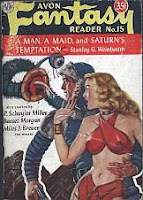
Donald A Wollheim (Ed)'s "Avon Fantasy Reader No 15" (February 1951, anthology, free): Table of contents & download links

Cover image of Avon Fantasy Reader No 15, February 1951, edited by Donald A WollheimWhole book is available as JPEG page scans online, but as part of a larger package. Download information.

Table of contents.

  1. Stanley G Weinbaum's "A Man, a Maid, & Saturn's Temptation" aka "Flight on Titan"; 1934: Not read.
  2. Mary Elizabeth Counselman's "Mommy"; 1939: Not read.
  3. Gilbert Wright's "The Great Gizmo"; 1945: Not read.
  4. Bassett Morgan's "Gray Ghouls"; 1927: Not read.
  5. Maurice Baring's "Venus"; Half a Minute's Silence: Not read.
  6. P Scheuyler Miller's "Ship-in-a-bottle"; 1944: Not read.
  7. Donald A Wollheim's "Up There"; 1942: Not read.
  8. Miles J Breuer's "The Einstein See-Saw"; 1932: Not read.
  9. John Martin Leahy's "In Amundsen's Tent"; 1928: Not read.
  10. Clarke Ashton Smith's "Ubbo-Sathla"; 1942: Not read.
  11. C M Kornbluth's "Kazam Collects"; 1941: Not read.
Related: Avon Science Fiction & Fantasy series.

Sunday, February 1, 2009

Donald A Wollheim (Ed)'s "Avon Science Fiction Reader No 1" (April 1951, anthology, free): Table of contents & download links

Cover image of Avon Science Fiction Reader No 1, April 1951, edited by Donald A WollheimWhole book is available as JPEG page scans online, but as part of a larger package. Download information.

Table of contents.

  1. Edmond Hamilton's "The War of the Sexes"; 1933: Not read.
  2. Frank Belknap Long's "Green Glory"; 1934: Not read.
  3. Clarke Ashton Smith's "The Immeasurable Horror"; 1931: Not read.
  4. Murray Leinster's "The Morrison Monument"; 1935: Not read.
  5. Wallace West's "The Incubator Man"; 1928: Not read.
  6. Sewell Peaslee Wright's "The Dark Side of Antri": Not read.
  7. Donald A Wollheim's "Blind Flight"; 1941: Not read.
  8. Abraham Merritt's "Rhythm of the Spheres"; 1934: Not read.
  9. R F Starzl's "Madness of the Dust"; 1932: Not read.
  10. Jack Williamson's "The Cosmic Express"; 1930: Not read.
Related: Avon Science Fiction & Fantasy series.

Saturday, July 19, 2008

Fritz Leiber's "A Pail of Air" (short story, post apocalypse, free): "survival in the face of desperate circumstances"

Quote from short story titled A Pail of Air by Fritz LeiberLeiber is another author I got introduced to via the wrong story, & kept avoiding. This one is a much better story compared to his "Coming Attraction" (included in Silverberg's SF Hall of Fame, vol 1).

While I won't put it in the league of best stories by anyone, it's a fine example of fighting extreme adversity with a positive outlook. Many familiar tropes have been mixed well.

Story summary.

A "black star" (or "dead sun") was moving through milky way in a direction opposite Sol, & passed rather close by. Earthmen never had a warning. At the time of passing earth was on one side of sun - towards black star; other planets were on the other side of the Sun.

In the gravitational tug of war between the Sun & the visitor, earth got torn away from Sun & was captured by the black star; moon was pulled in by Sun - so earth doesn't even have moon now. There were major geological upheavals on earth at the time of passing - leading to much destruction. Parts of this narrative sound like H G Wells' "The Star".

More than a decade has passed since the event. Earth is now in orbit around this new sun, & its axial rotation period is now 10 times longer. It's now a dead frozen world with no sunlight, currently "beyond the orbit of the planet Pluto", moving "farther out all the time."

A hardy man named Harry not only survived with his wife, they decided to have children after the event & teach them what it takes to survive in this harsh world. No one else is known to be alive, though near the end of the story they will not only meet other survivors but find hope in this world.

Story is narrated by the 10 year old son of Harry. His accounts of the events are based on what he has heard from his parents - he himself has never known a friendlier earth. Fourth member of the family is his sister. Family has figured out a way of living in a makeshift shack ("Nest") that is not airtight.

They burn coal for fire that they get from somewhere on a lower floor of the old building that now houses the Nest & is mostly under the frozen atmosphere; these coals were may be previously collected (I'm not clear). Living off old canned food, I think - I don't recall many mentions of food sources.

Title comes from buckets of solid oxygen the family needs to collect from outside & melt in fire indoors - since earth's atmosphere is now frozen.

Some interesting descriptions of this world:
  1. "when the Earth got cold, all the water in the air froze first and made a blanket ten feet thick or so everywhere, and then down on top of that dropped the crystals of frozen air, making another white blanket sixty or seventy feet thick maybe."
  2. "all the parts of the air didn't freeze and snow down at the same time."
  3. "First to drop out was the carbon dioxide... Next there's the nitrogen ... it's the biggest part of the blanket. On top of that and easy to get at, which is lucky for us, there's the oxygen that keeps us alive. Pa says we live better than kings ever did, breathing pure oxygen... Finally, at the very top, there's a slick of liquid helium, which is funny stuff. All of these gases in neat separate layers."
  4. "Odd things happen in a world that's about as cold as can be, and just when you think matter would be frozen dead, it takes on a strange new life. A slimy stuff comes crawling toward the Nest, just like an animal snuffing for heat—that's the liquid helium." There is a mention of a similar effect in Larry Niven's "Wait It Out" (set on Pluto).

Collected in.

  1. David Drake, Jim Baen, & Eric Flint (Ed)'s "The World Turned Upside Down".

Fact sheet.

First published: Galaxy Science Fiction, December 1951.
Rating: A
Download full text or MP3 (later via Wikipedia).
Update 20 July 2008: Michael Williams' comment below gives a link to a 1 hour unabridged version, as opposed to my MP3 link above which is a dramatization; I haven't heard either of the two MP3s. Thanks Michael.

Saturday, May 3, 2008

** C M Kornbluth's "The Marching Morons" (novelette, satire)

A variation on "selling ice to Eskimos" theme. A no-morals man from our time ends up in a future where average IQ is 45, & there is an exclusive breed of smarter people confined to Antarctica. In a deal that promises to make him the ultimate dictator, this man helps the smart ones kill off rest of humanity by selling them a story that makes them want to march off to their death.

Collected in.

  1. Ben Bova (Ed)'s "The Science Fiction Hall of Fame, Volume Two A".

Fact sheet.

First published: Galaxy, April 1951.
Rating: A

Note: Why is this post so short?

** Anthony Boucher's "The Quest for Saint Aquin" (short story, science fiction)

In a future dystopia where most people have fallen back to primitive existence, the very few ruling elite are technologically advanced & planet-faring, & where Christianity is banned in the US, an underground Christian movement in California has sent an agent to confirm rumors of a messiah in a remote village. And he gets astonished after discovering the thing that makes the long dead body of this rumored messiah special.

Collected in.

  1. Robert Silverberg (Ed)'s "The Science Fiction Hall of Fame: Volume One, 1929-1964".

Fact sheet.

First published: Raymond J Healy (Ed)'s "New Tales of Space & Time" (1951).
Rating: B

Note: Why is this post so short?

Thursday, May 1, 2008

** Arthur Clarke's "Holiday on the Moon" (as by Charles Willis) (short story)

Among the most accessible moon travel stories by Clarke for non-technical audience. Seasoned science fiction readers will find the fare familiar. Told from the perspective of an 18 year old girl generally disinterested in technical stuff.

Fact sheet.

First published: as a four part serial in Heiress magazine during January to April 1951, under the pen name of Charles Willis.
Rating: A

Note: Why is this post so short?

** Arthur Clarke's "The Road to the Sea" (short story)

One of the more muddled stories by Clarke, with many threads that are only loosely linked. A prosperous future where humans are divided by those who wish to live on earth, & those who seek out the stars.

Fact sheet.

First published: in Two Complete Science-Adventure Books, Spring 1951, under the title "Seeker of the Sphinx".
Rating: B

Note: Why is this post so short?

Wednesday, April 9, 2008

Eric Frank Russell's "The Witness": (short story, science fiction): Should this refugee be granted asylum?

Quote from short story titled The Witness by Eric Frank RussellThis must be among the most entertaining from Russell. Very interesting court room drama, crisp dialogs, emotionally charged atmosphere - & sometimes amusing too.

There is something I noticed in common with Tom Godwin's "The Cold Equations": if you are asked to pass guilty or not guilty verdict against two individuals, & where all other things are equal, the verdict is different depending on whether the accused is a man or a young girl! There is a strong undercurrent of this in both stories.

There is a short outside court room part near end of the story. But most interesting parts are in the court room scene. I had a feeling that some of the emotions, at least through part of the court room drama, were similar to Ayn Rand's "The Night of January 16th".

If you intend to read this story soon, please stop here. Reading summary below will seriously spoil the fun.

Story summary.

Maeth aka "Spike" is an alien, & "it came from some planet in the region of Procyon. Three feet high, bright green, with feet that were mere pads, & stubby limbs fitted with suckers & cilia, it was covered in spiky protrusions & looked somewhat like an educated cactus. Except for its eyes, great golden eyes... A toad, a wistful toad".

Date is "May 17, 1977". Court is somewhere in the US - a "special court, held by international agreement". Maeth is the accused - an illegal alien. Case has received worldwide publicity. Public, media, & some of the judges seem to have already concluded the accused guilty. "A minority of spectators hoped for life, many lusted for death, while the waverers compromised in favor of arbitrary expulsion".

Case hearings will be publicly broadcast. Jury is all of public (I suppose American adults), & there is some kind of voting system that will decide the verdict!

Maeth "can neither hear nor speak, but can comprehend us telepathically & respond visually." This "respond visually" comprises of writing answers with chalk on a blackboard. It also has many other abilities we will learn through the drama: telepathically paralyze someone to defend itself, move through glass as if there were no barrier - leaving a hole its shape in the wake, ...

Charges are "generally of illegal entry into this world known as Earth & specifically into the United States of America."

Alien apparently landed in the cultivated fields of Samuel Nall, causing some damage to crops. Panicky man called the cops. Samuel claims Maeth didn't show any remorse - never mind he cannot read any emotions on Maeth's face, or that alien cannot be expected to understand valuable crops just on landing.

Joseph Higginson, the cop, tried to shoot the alien! In self defense, alien telepathically paralyzed the cop, "but it wore off after a couple of hours" without any lasting effects. Alien "therefore obstructed a police officer in the execution of his duty, assaulted a police officer, and resisted arrest"! Never mind that alien cannot recognize a local cop as such.

Dominic Lolordo, owner of "a sea food restaurant", is accusing Maeth of theft. It entered after closing hours, "walked in through the window... leaving a hole its own shape. It went out the same way, making another hole. No broken glass around, no splinters, nothing." Alien apparently came to eat "Lobsters and oysters" - "In other words, a square meal".

Winthrop Allain, "a resident professor of zoology", has studied Maeth for a while, & seems to be unemotional & factual. He tells the court the alien is not only intelligent, it's as intelligent as "we are, though in a different way." His testimony will be tweaked by prosecution attorney, & we see a lot of fear mongering about hoards of alien invaders.

Many witnesses later, we will learn the story of Maeth. Its people have a hive-mind - only its parents were biological freaks & had their own individual minds, & passed the trait on to Maeth. Parents were killed "for having minds of their own"; Maeth was being hunted to be killed when it escaped by stealing a short range spaceship. It rode first asteroid it met that was moving in some random direction away from home world. By chance, it was headed towards earth. Last leg - off asteroid & to earth - was again in the stolen ship. That is how it ended up here.

Near the closing of proceedings where the public voting of guilty is a near certainty, defense attorney drops his bombshell - with the help of Prof Winthrop Allain. We learn that Maeth is "Fairly young... Not quite an adult." And a female. That is the turning point. Civilized people don't prosecute "a small & lonely female", right?

Happy ending, but after some more drama.

Fact sheet.

First published: Other Worlds Science Stories, September 1951.
Rating: A
Related: All stories of Eric Frank Russell.

Thursday, January 24, 2008

Hal Clement's "Iceworld" (novel, science fiction): What we see depends on what we are!

Quote from the novel titled Iceworld by Hal ClementIf you intend to read this novel soon, take my advice - any review (& book blurb too, at least for some editions) will spoil the magical introduction to Iceworld near the end of chapter 1; rest of the story is gripping - & sometimes amusing - but spoilers probably won't hurt. Read any reviews only after you are through chapter 1.

If you haven't read anything by Clement yet, please note that he is not for everyone. This note gives some idea of what to generally expect from his stories, hopefully without spoiling the fun.

Table of contents.

It's a very long post - hence ToC.
  1. Executive summary.
  2. Sarr, the planet.
  3. Sarrians, the intelligent star faring aliens.
  4. Sarrian protagonists.
  5. Human protagonists.
  6. First contact.
  7. Main story.
  8. Fact sheet.

Executive summary.

Sallman Ken has been recruited by policeman Rade as a mole in the drug peddling gang of Laj Drai. Drai expects him to help increase supply of the exotic drug he has been sourcing from the natives of a very cold alien world. Idea is to figure out the atmosphere & soil of this alien world, & set up their own farm to grow the drug in bulk.

Story is primarily about the fun of figuring out this cold world.

Sarr, the planet.

Main protagonists come from this world.

Its star is 212 parsecs from our sun.

It's a very hot world; local beings consider 500ºC as normal comfortable temperature! Standing under a vertical Sun on Mercury, at 400ºC, the alien visitors feel very cold. This is the key feature of the story - Sarrians exploring earth ("Iceworld" of the title) that is way too cold for them.

A day there is "about thirteen Earthly hours".

On this world, sulfur plays the role that oxygen does on earth. Local life breaths sulfur; local plants produce it.

A Sarrian year is 1.5 times that of earth.

An alien visitor is given some information about earth on arrival, in the form of comparisons with Sarr: earth "atmosphere has a pressure around two thirds of Sarr normal, and at its base the temperature is low enough to freeze most of the regular gases out of our own air - I believe it would even freeze potassium... and lead, and tin! ... The planet is about three-tenths larger than ours in diameter, making its volume rather over twice as great as that of Sarr. Its mass is also over twice ours, though its average density is a shade less. Surface gravity is one and a quarter Sarr normal. Mean temperature is a little below the freezing point of potassium. Atmospheric pressure uncertain, composition unknown. Period of rotation, one point eight four Sarr days."

Sarrians, the intelligent star faring aliens.

They are the main protagonists in the story. Humans play a secondary role.

While visitors are from planet Sarr, it's not the home world of their race; it was colonized by their kind some time in the past.

We don't know much about their physical build except the following:
  1. They have 6 limbs. 4 in places where we have arms; 2 where we have legs. Story refers to their arms as tentacles. There is a scene where humans see a Sarrian for the first time. Humans aren't very scared because he doesn't look so different when wearing his heavy suit - he has two of his tentacles tucked in each arm of the suit, so looks like he has two arms & two legs!
  2. This bipedal also has his height that is just right - a bit less than that of European male, but not by much.
  3. He has two eyes, but they normally move them independently - to simultaneously take in two scenes.
They are technologically way too advanced compared to humans. Star travel is common for them. Visitor's ship is "capable of exceeding the speed of light by a factor of several thousand".

Sarrian protagonists.

Sallman Ken is a school teacher (science teacher?), recruited by the "narcotics chief" Rade. To be planted as a mole in the gang of Laj Drai, a ruthless drug peddler.

The most profitable venture of Drai is tobacco that he sources from a human supplier on earth. I could not figure out why carbon-based tobacco is so dangerous for these beings, but let's believe the author. "The special menace of this stuff seems to lie in the fact that it is a gas, and can therefore be administered easily without the victim's consent; and it seems to be so potent that a single dose will insure addiction." Note tobacco is a "gas" at Sarrian temperatures. The "stuff doesn't keep at normal temperature. It has to be held under extreme refrigeration; when exposed to normal conditions it breaks down in a few seconds."

Drai has been running this business now for 20 earth years - in the year of the story, around 1950 (30 years after World War I). He runs this off a base on Mercury. In the story, Mercury is tidally locked to sun, always showing the same face to sun (now known to be factually incorrect). His base is, of course, on sun facing side of Mercury, & that still is not hot enough; they need artificial heating.

But it wasn't Drai who discovered that earth was inhabited, & had the valuable tobacco. It was someone unnamed & now dead, 30 earth years ago. An earlier owner of the ship Karella - "a fairly common type of interstellar flyer, somewhere between one hundred fifty and two hundred feet in length, and about one third that diameter. It would be shaped like a cylinder with slightly rounded ends." Drai had "inherited the ship and got into this trading business" 20 years ago.

Since it has been the same human involved all through, I didn't quite figure out how the contact was kept alive during the first 10 years.

Earth & tobacco are a closely guarded secret of the gang. The reason the gang doesn't directly travel from Sarr to Sol, & take a longer round about route.

There are two other Sarrian characters that play a major role:
  1. Feth Allmer is the reluctant handy technical man of Drai. He himself was a police mole, but was forcibly made an addict by Drai to ensure loyalty.
  2. Ordon Lee is very loyal to Drai, & pilots his ship Karella.

Human protagonists.

All human protagonists are from US, somewhere near "the border of Montana". And from a single family.

John Wing is the head of the family, & the only one who knows the secret of trading with aliens. He accidentally got into the trade as a young man a little after World War I - sells tobacco in the form of cigarettes in return for solid "platinum and indium nuggets"! Apparently, platinum is as valuable to Sarrians as iron is to us; they can pick it up in any quantity from all over the place. This trade is the main source of income for John.

Close to their holiday home "near Lake Pend Oreille" is a homing beacon planted by aliens; this is where alien unmanned trading "torpedoes" arrive. "We've sort of fallen into a schedule over the years. I'm never here in the winter any more, and they seem to realize that; but from two to three days after I snap this switch off and on a few times, ... the exchequer gets a shot in the arm." Family spends winter elsewhere.

Note: Google search shows "Lake Pend Oreille" is in Idaho. I'm not familiar with the US geography, but story only mentioned Montana. Do the two states share border?

Rest of the family thinks John is a platinum miner - & owns a secret mine. At least in the beginning of the story. Family includes his wife (either unnamed, or I must have forgotten marking the name), & 5 children - Donald, Roger (13), Edith, Marjorie (8), & Billy (6). By the end of the story, not only will the family know the secret, but we will learn that it comprises of super-smart kids. Roger plays quite a substantial role in the story.

First contact.

Interesting story in its own right - for what it's worth.

Unnamed alien adventurer had been moving through Sol in his ship Karella a little after World War I when he noticed an apparently lifeless earth. His ship was equipped with any number of "torpedoes" - unmanned remotely-guided exploration vessels that could not actually move on planetary surface, just land somewhere & observe the surroundings.

The earth is so cold for them - pretty much all their instrumentation failed in upper atmosphere. The only thing that survived is sound system - a loudspeaker, & a microphone. This is how contact & trading will begin - "We don't exactly talk to them, but they can apparently hear and produce sounds more or less similar to those of our speech." But that is later.

First 19 torpedoes were sent "to make the landings on one of the relatively smooth, bluish areas; they seemed the least complicated." (oceans - aliens are unused to the concept of any kind of liquid existing at normal temperatures). "most of them were reaching the surface - and going out of action the instant they did so. Something was either smashing them mechanically or playing the deuce with their electrical components... this steady loss of machines could not be due to chance; somewhere there was intelligent intervention... a race lived on the flatter parts of the planet; a race that did not want visitors." (apparently sunk - either the remote signals don't penetrate water, or its machinery is damaged).

This myth of hostile beings on flatlands will be finally broken near the end of the story.

They finally try landing something in rougher parts. As chance has it, John will be the only human near the place of landing. First contact will be a sort of advanced version of first story in Arthur Clarke's "
2001 A Space Odyssey": Wait a while after landing, listening to local sounds. Then make a noise. Notice any responding noises - probably local animals.

Finally some complex sounds that indicate the being is somewhat intelligent. Show him a "swap box" (by opening a compartment near the bottom of torpedo) - "two trays, hinged together, each divided into a number of small compartments. One side is empty, while the compartments of the other are filled with various articles that are for sale. A glass lid covers each of the full compartments, and cannot be removed until something has been placed in the corresponding compartment of the other tray." A few iterations, & both parties know what the other values - tobacco for platinum! In the process, aliens also learn the sound of a very few English words, & guess their meaning.

Aliens don't mind giving "platinum-group nuggets ... - they're easiest to come by; there's an outcropping of the stuff only a short distance from this station, and it's easy to send a man out to blast off a few pieces. I don't know what they use them for - for all I know they may worship the torpedo, and use the nuggets as priests' insignia."

Main story.

Ken is the hero; most of the story is told from his perspective. After recruitment, he is taken by Drai & gang to Sol via a rather roundabout route - journey lasted 22 days (Sarrian, I suppose). "Twenty-two days was a long journey - if it had been made in a straight line". He will first be shown moon, then earth - we see some horrified reactions about these obviously inhospitable worlds & the "remarkably feeble sun... It was dim enough to view directly without protection to the eyes; to Ken's color sense, reddish in shade and shrunken in aspect. No world this far from such a star could be anything but cold."

Finally they go to gang's base on Mercury where he will meet & befriend his future alley Allmer.

What Drai really wants out of Ken is: figure out a way of growing tobacco so they don't have to depend on earthmen. His main problem is not the price or effort of trading, but the quantity: "We get it ... in trickles... Basically, your problem is - how do we get more of it"? "I don't mind the price - it's the quantity. We only get a couple of hundred cylinders a year - one of Three's years, that is. That doesn't let us operate on a very large scale." "Cylinder" is a cigarette. "Three" is earth - planet #3.

Idea is to pick up a natural cavern on the "dark side" of Mercury, make it airtight, fill it up with atmosphere, soil & anything else needed from earth, & then grow their own tobacco. Drai is even considering kidnapping some humans & enslaving them to actually do the tobacco farming for him on the cold tobacco farm.

Ken's first task is to figure out earth's atmosphere. We slowly learn why so little is known to these aliens about earth - Allmer has been quietly sabotaging all attempts to figure out earth.

Anyway, Ken designs chemistry experiments, sets up a lab on board an automated torpedo with Allmer's help, sends it down to earth. Some problems, multiple trips, & finally he is making progress determining the composition of earth's atmosphere.

Ken is also planning a "manned" trip down to earth's surface. A specially built suite is sent hanging outside a torpedo - it's too big to fit inside; he himself will later visit the same way - by hanging outside! They will find, on its return, that the suit leaked. Ken will finally figure out the cause with Allmer - Allmer had sabotaged. Ken convinces Allmer of the need to learn more about earth, & assures the knowledge won't be used to aid Drai.

Things will then move a bit faster.

Drai is getting impatient. Ken thinks the job will take a long time, & will require transporting large amounts of soil from earth - and still won't be sure what minerals are lacking on their artificial farms. Under pressure from Drai, Ken figures other planets of Sol might not be too different from earth. But Mercury obviously is; so is moon. They go to Mars looking for soil - Ken, Drai, & Lee. This happens before Ken & Allmer become friends.

They land near Martian pole, intrigued by the white substance that looks similar to white substance at earth's poles. Cautious exploration, a near-fatal accident, & amazement - their hot bodies ensure ice evaporates as soon as they touch it! Finally, Ken will figure out it's an oxide of hydrogen.

Drai has been getting suspicious about Ken. Ken seems to have figured out the distance to & location of Sarr relative Sol on his own, & also the name "tofacco" (alien's reading of English "tobacco"). On the trip back from Mars to Mercury, Ken will be subjected to tobacco vapor to make him an addict, & to ensure his loyalty - since Drai controls the supply.

I don't recall if they learned much about the soil from the Martian trip - only the existence of ice, & an idea that oxygen can play the role that sulfur does on their world. This, combined with cooperation of Allmer, will substantially speed up the figuring out of earth.

Eventually, the day comes when Ken actually lands on earth. And figures anything he touches seems to burn - grass, wood, whatever. He will accidentally meet Roger. And make humans suspicious - "after twenty years of mere trading, they suddenly are starting to explore?"

Several more trips. Ken is now almost a friend of Wing family. Based on the time lag between the actual arrival of trading torpedo after the ready button is pressed on alien beacon, the family has figured out the aliens come from Mercury; that they like it hot seems to corroborates the thesis.

One fine day, Ken is talking to Wing family near their home. That is when John drops the bombshell - not only displays his knowledge of solar system, but his idea that aliens are probably coming from Mercury. Drai, listening over radio in his ship that is hovering over earth, is suspicious that Ken is playing games. Brings the ship down, causing fire in the woods near Wing family home. Roger & Edith nearly die in ensuing chaos but are rescued in time with help from Ken. This was a trading day, & aliens didn't get their tobacco - because the Wing family was busy fighting the fire.

Up in the ship. Drai proposes violence. To hold the power of creating fire to keep the humans in check. They go down. Fire is still razing, & they consider it prudent to keep invisible to other humans. Hover over a valley. See a lake & try exploring; lose one of their torpedoes in water again. Get some idea of what the flatlands are. Go exploring out to sea & figure of the substance is the same as the one at Martian pole.

Up again in ship. Drai is hell bent on violence; he knows he wields enormous power over humans, now that the threat of hostile flatlanders has been proved to be a myth. Ken stages a coup with the help of Allmer; under threat of exposure to tobacco that Ken had received as gift during one of his trips down, Lee will be made to cooperate.

Before taking the ship back to Sarr to tell their world about earth, humans will receive not only their payment in platinum against gifted tobacco, but also information about Sarr's location & that aliens will be back after a while for peaceful exchanges.

Fact sheet.

"Iceworld", novel, review
First published: As a 3 part serial in Astounding Science Fiction in October/November/December 1951.

Rating: A
Listed in "grubthrower"'s "Top 10 Obscure But Superb Science Fiction Novels".