Showing posts with label Isaac Asimov. Show all posts

Saturday, March 15, 2014

Isaac Asimov's "No Connection" (short story, puzzle, free)

Millions of years into future, man is long extinct. The world has two dominant intelligent races:
  1. Americas dominated with "Gurrows", intelligent descendents of bears;
  2. Rest of the world dominated by "Eekahs", intelligent descendents of chimpanzees.
Eekahs are far more technologically advanced, are aware that Americas are sparsely populated, & are planning raids to claim that land.

This is the story from the point of view of a Gurrow archeologist who knows a bit about the long extinct man (the "Primate Primeval"). And of his seriously incomplete piecing together of the history of the continent & what lays ahead as they come into more frequent contact with Eekahs...

Collected in.

  1. Everett F Bleiler & T E Dikty (eds)' "The Best Science Fiction Stories: 1949".

Fact sheet.

First published: Astounding, June 1948.
Download full text from AlfaLib.
Rating: A.
Related: Stories of Isaac Asimov.

Monday, August 26, 2013

Isaac Asimov's "Silly Asses" (flash fiction, satire, free)

It's a commentary on the first nuclear (weapons?) tests - wise alien's reaction to discovery that the man has detonated a nuclear device on his own world.

The SFFAudio link below has more on the immediate political background to the story.

Fact sheet.

First published: Future Science Fiction, February 1958.
Download full text & audio from SFFAudio. [via QuasarDragon]
Rating: B.
Related: Stories of Isaac Asimov.

Sunday, February 17, 2013

"Astounding Science Fiction" (British edition), April 1957 (ed John Campbell) (magazine, free): Annotated table of contents

Cover by Van Dongen of British edition of Astounding Science Fiction magazine, April 1957 issue.
I think I've read "2066: Election Day" in one of the "Issac Asimov Presents Great SF Stories" books. An unusual "election" for a US President, an election where people don't vote at all, & one that was actually rigged by a small coterie. I don't think I came back happy with it, & the ending invoked in me an angry reaction - "how could the author propose this to be a good outcome?" type of reaction.

Links on author fetches more fiction by author. Where I have a separate post on a story, link on story title goes there. For stories I've read, my rating is in brackets.

Table of contents.

  1. [novelette] Robert Silverberg & Randall Garrett's "False Prophet" (as by Robert Randall): "There are times when it is exceedingly unwise to tell the truth--& the Nidorian was dedicated to truth. The Earthmen were wiser; they lied about him."
  2. [ss] Michael Shaara's "2066: Election Day": "There is a limit to any process you can name ... & sooner or later that limit will be reached. Then ... somehow you have to fumble togeather a new thing..."
  3. [ss] Algis Budrys' "Look on My Works" (B): Tourist guides milking a tourist from Centaurus with fakes, in a far future New York city...
  4. [ss] Robert Silverberg's "To Be Continued" (A): Slow life is frustrating!
  5. [serial - 3/3] Isaac Asimov's "The Naked Sun": "Lije Baley had a triple-decker problem to solve--& solved it only because a robot tried to give him a hand. And thereby taught him to define his terms with a new exactness!"

Fact sheet.

Labeled: "Vol XIII No 4 (British Edition)".
Download scans as a CBR file [via Bob@pulpscans]
Note: The link fetches a RAR file that contains the target CBR, probably to work around hosting service's file naming constraints.
Related: Stories from the Astounding/Analog issues edited by John Campbell, old "pulps", 1950s.

Monday, February 4, 2013

"Astounding Science-Fiction", May 1941 (ed John Campbell) (magazine, free): Annotated table of contents & review

Cover by Rogers of Astounding Science-Fiction magazine, May 1941 issue.
I've read stories of Heinlein, Asimov & Russell elsewhere; am posting this only for the two unread shorts - "Fish Story" & "Subcruiser".

Links on author fetch more stories of author. Where I've a separate post on a story, link on story title goes there. My rating for stories I've read & still remember appears in brackets.

Table of contents.

  1. [novelette] Robert Heinlein's "Universe"; MP3 of radio adaptation: "an unique & fascinating civilization in a spaceship that missed its goal!"

    Collected in "The Science Fiction Hall of Fame, Volume Two A" (ed Ben Bova).

    See also: its sequel, "Common Sense", in Astounding, October 1941.
  2. [novelette] Robert Heinlein's "Solution Unsatisfactory" (as by Anson MacDonald): "a story of the very near & grimly probably future. Man's apt to have that irresistible weapon soon--& no method of control!"
  3. [ss] Isaac Asimov's "Lier!": "Herbie was a robot; he was also a mistake. Somewhere in the assembly, an accident made him telepathic, with inevitable & disturbing consequences!"
  4. [ss] Eric Frank Russell's "Jay Score" (A): A passenger ship on earth to Venus voyage is hit by a meteor, & is now headed for Sun! 
  5. [ss] Vic Phillips & Scott Roberts' "Fish Story" (B): A "fishing" adventure on Venus.
  6. [ss] Harry Walton's "Subcruiser" (B): Foiling a warship hijack.
  7. [serial - 2/2] L Sprague de Camp's "The Stolen Dormouse": "In a slightly delirious world of the future where noble Sir Businessman feuds, & the times are more than a little out of joint."

Fact sheet.

Labeled: "Vol XXVII No 3".
Download scans as a CBR file. [via Bob@pulpscans]
Related: Stories from the Astounding/Analog issues edited by John Campbell, old "pulps", 1940s.

Saturday, November 17, 2012

Isaac Asimov's "Playboy and the Slime God" aka "What Is This Thing Called Love?" (short story, parody)

One of the illustrations by Summers accompany the short story Playboy and the Slime God by Isaac Asimov in Great Science Fiction from Amazing, #1. Image shows the alien coaxing the woman it has kidnapped into removing her cloths.
Skip it if the discussion of sex embarrasses you.

The moment I read the first line, I knew I'd read the story before. But it's been some years, so I read it again. And wasn't disappointed.

This is a hilarious parody of bug-eyed monsters from outer spaces coming to earth to kidnap girls to satisfy their sexual urges. Plus there is a ... sort of critique of Playboy magazine.

Story summary.

Slimy alien scientist from far off part of galaxy kidnaps a man & a woman to demonstrate to his boss that earth is a major danger to galaxy & must be destroyed. Danger because its creatures don't "bud" singly to produce the young as is the norm everywhere, but reproduce by combining genes from two separate individuals, thus significantly accelerating the evolution. Only problem is: his knowledge of human reproduction & anatomy is limited to Playboy magazine & bug-eyed monster kind of sf literature.

Hilarity ensues as the two aliens coax the man & the woman to couple & produce a child...

Notes.

From editor's introduction to this story in "Great Science Fiction from Amazing", #1:

'Several months ago a magazine named Playboy, which concentrates editorially on girls, books, girls, art, music, fashion, girls & girls, published an article about old-time science-fiction. Called "Girls for the Slime God," it was illustrated with synthetic covers of non-existent sf magazines, each replete with bug-eyed monster, mad scientist, & partially naked, nubile girl.'

'We commissioned one of sf's most sex-appealing writers to create a story especially for the insatiable Playboy, & to prove to him that sf has not forgotten that S-X is the most important thing in the Universe.'

Fact sheet.

First published: Amazing Stories, March 1961.
Rating: A.
Related: Stories of Isaac Asimov.

Saturday, April 28, 2012

Groff Conklin (ed)'s "Six Great Short Science Fiction Novels" (anthology): Annotated table of contents & review

Cover of short story anthology Six Great Short Science Fiction Novels, edited by Groff Conklin
Going by what I've read so far, there is less emphasis on entertainment value here & more on stories with cool ideas.

List below is in order of my preference - best first, unread last. Links on author, publisher, or year fetch more matching fiction.
  1. [novelette] Isaac Asimov's "Galley Slave" (A); Galaxy, December 1957: How to make a 3-laws obeying robot harm a human...
  2. [novella]  Damon Knight's "Rule Golden" (A); Science Fiction Adventures, May 1954: What if we had an additional empathy sense? 
  3. [novelette] Algis Budrys' "Chain Reaction" (as by John A Sentry) (B): You're free, but live my way!
  4. [novella] Judith Merril's "Project Nursemaid" (B); F&SF, October 1955: Government's difficulties recruiting unwanted babies... 
  5. [novelette] Clifford D Simak's "Final Gentleman" (B); F&SF, January 1960: Which of the 2 realities he experienced is real?
  6. [novelette] Katherine MacLean's "Incommunicado" (B); Astounding, June 1950: Creating Homo Superior by rewiring part of human brain that processes auditory inputs...
First published: 1960.
Related: Anthologies, collections, magazines.

Thursday, April 19, 2012

Isaac Asimov's "Galley Slave" (novelette): How to make a 3-laws obeying robot harm a human...

Quote from short story Galley Slave by Isaac Asimov
This story pits for-automation folks against those against-automation, because it will result in job losses & loss of human purpose (in remaining busy doing certain occupations?)

Most of the story is a courtroom trial. Prof Simon Ninheimer was against Robot EZ-27's employment by his university from the very beginning; the idea that a new type of robot can take over routine intellectual tasks like proofreading was totally unpalatable. So he set out to destroy the reputation of US Robots, its makers, by an unusual court case...

Collected in.

  1. Groff Conklin (ed)'s "Six Great Short Science Fiction Novels".

Fact sheet.

First published: Galaxy, December 1957.
Rating: A. 
Related: Stories of Isaac Asimov.

Saturday, October 30, 2010

"Venture Science Fiction", #9 (Vol 2 No 3) (May 1958) (ed Robert P Mills) (magazine, free): Annotated table of contents

Cover of Venture Science Fiction magazine, May 1958 issue. Artist M S Dollens, showing Night on Titan from story The Comedians Children by Theodore Sturgeon
Scans of this magazine in CBR format are online as part of a larger package.

Table of contents. 

Links on authors fetch more fiction by author. Where I have a separate post on a story, link on story title goes there.

  1. Edmond Hamilton's "The Dark Backward": "In winter, on an island off New England coast, you get used to wind-lashed surf, to hardship & struggle, to the cold, lonely life. May be you get so used to it that you don't want to hear when the bright future calls..."
  2. [non fiction] Isaac Asimov's "The Big Bang": "Neutronium, as everybody knows, is heavier than anything...& doesn't exist. Dr Asimov here gives details of what it would be--& what it might actually have been!"
  3. Arthur C Clarke's "Cosmic Casanova" (A): "I was two months out on solo galaxy scouting trip, & I was ... restless. And then I contacted an unknown planet that might be one of Earth's lost colonies... Could be a date was closer than I thought."
  4. [novelet] Rog Phillips' "Ground Leave Incident": "To a young country couple on an isolated, hardship planet, a spaceship visit is a special event. There is the trip to town, new clothes, the smell of fresh food & spices... There are also the hot, demanding eyes of women-hungry crew."
  5. [non fiction] Theodore Sturgeon's "On Hand...Offhand".
  6. Gordon R Dickson's "Fleegl of Fleegl": "Fleegl was a rabbity-looking sort, with four arms, a force field, & a conviction that people were demented. He also had an extraordinary space tube a missionary's zeal, & a regrettable resistance to fission bombs & reason..."
  7. Algis Budrys' "A World Named Mary" (as by Robert Marner): "Bill & Mary found the planet, & it was beautiful. Which pleased Mary, but didn't surprise her--she was accustomed to getting what she wanted. Then Bill named the planet after her--& everything changed..."
  8. Isaac Asimov's "Buy Jupiter!": "The aliens were strong enough simply to take Jupiter, but for some reason they wanted it all legal. And the price they offered was fine. Thing was--why did they want the gassy old thing...?"
  9. [novelette] Theodore Sturgeon's "The Comedian's Children": "Everybody--almost everybody--loved unsmiling Heri Gonza, the world's funniest man. Look how he took over when that frightening children's disease was brought back from Iapetus. He gave wholly of himself, gave his money, his love, his talent... The one thing he didn't give was a cure. That seemed to be locked in the mind of Gonza's most dedicated enemy--& on the frozen surface of Saturn's eighth satellite..."
  10. [non fiction] Robert P Mills & Judith Merril's "Venturings".

See also.

  1. Fiction from old "pulp" magazines.
  2. Fiction from 1950s.

Friday, August 20, 2010

"Astounding Science-Fiction", Vol XXVIII No 2 (October 1941) (ed John W Campbell, Jr) (magazine, free): Annotated table of contents

Cover by Rogers of Astounding Science-Fiction magazine, October 1941 issue
Scans of this magazine in CBR format are online as part of a larger package.

"By His Bootstraps" & "Universe" (download MP3 of radio adaptation) are among Heinlein's best known stories. Though not among his best stories, in my opinion. Former appears in "The Adventures in Time & Space"; later in "The Science Fiction Hall of Fame, Volume Two A".

Table of contents. 

Links on author fetch more fiction by author. Where I'm aware of other online copies of a story, I include them too.

  1. [novella] Robert Heinlein's "By His Bootstraps" (as by Anson MacDonald) (B); download MP3 of radio adaptation; grandfather paradox: "Bob Wilson met himself--in a highly redundant sort of way. He met himself several times in fact, & became inextricably tangled in Time--"
  2. [novelette] Robert Heinlein's "Common Sense": 'The sequel to "Universe", a tale of a civilization that developed aboard a giant spaceship lost in interstellar space for 4,000 years--"
  3. [ss] Isaac Asimov's "Not Final!": "The Jovians wanted to get out & destroy every other living thing in the Solar System. They would--if they could find a way to retain their terrific atmosphere in a spaceship--"
  4. [ss] Winston K Marks' "Manic Perverse": "Only mechanical violence could bring death in that era--& the force field kept men from committing suicide. And that alone was enough to make some mad--"
  5. [ss] Theodore Sturgeon's "Two Percent Inspiration": "A Martian might be as good as any Earthman in most things--but when it came to a short hike on Mercury--"

See also.

  1. Fiction from Analog/Astounding (only issues edited by Harry Bates, John Campbell).
  2. Stories written by John Campbell.
  3. Fiction from old "pulp" magazines.
  4. Fiction from 1940s.
Note: I could not find any mention of editor's name either on cover or on ToC page or with signature at the end of editor's column. ISFDB, however, note that the editor is John W Campbell, Jr.

Saturday, August 14, 2010

"Astounding Science Fiction", October 1955 (British Edition) (ed John W Campbell, Jr) (magazine, free): Annotated table of contents

Cover image of October 1955 issue of British edition of Astounding Science Fiction magazine. It shows a scene from the movie Conquest of Space, from Paramount Pictures.
Scans of this magazine in CBR format are online as part of a larger package.
Caution: Cover advertises a story - Charles F Hockett's "How to Learn Martian" - but it's not listed in ToC! It is, however, included in the internal pages.

"Allamagoosa" is among the best of science fiction. I'm sure I've seen "Risk" somewhere, but cannot quite place it.

Table of contents. 

Links on author fetch more fiction by author. Where I'm aware of other online copies of a story, I include them too.

  1. [novelette] Everett B Cole's "Millennium": "There are devices a high-level culture could produce that simply don't belong in the hands of incompetents of lower cultural evolution. The finest, & most civilized of tools can be made a menace..."
  2. [novelette] Isaac Asimov's "Risk": It was guaranteed not to kill anybody--wouldn't harm a hair of your head. Of course, it did tend to turn you into a mindless idiot--but it wouldn't hurt you a bit."
  3. [ss] Eric Frank Russell's "Allamagoosa" (A); download: 'Just what it was, they weren't quite sure, but they knew it had to be there; the Bureau's Inventory said so. And the consequences of its "accidental" destruction were astonishing...'
  4. [serial - 2/4] Poul Anderson's "The Long Way Home": "They weren't exactly welcome on Earth 5,000 years beyond their time--but they were hotly contended for. Nobody liked them, but everybody wanted them--particularly the one who wasn't there!"
  5. Charles F Hockett's "How to Learn Martian": "Once upon a time, people thought that a vocabulary & the grammar rules were the whole story on learning a language. But modern linguistics finds it's both more complicated, & also somewhat simpler than that..."

See also.

  1. Fiction from Analog/Astounding (only issues edited by Harry Bates, John Campbell).
  2. Stories written by John Campbell.
  3. Fiction from old "pulp" magazines.
  4. Fiction from 1950s.

Friday, June 11, 2010

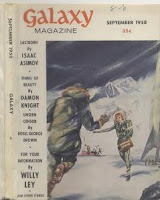
"Galaxy Magazine", Vol 16 No 5 (September 1958) (ed H L Gold) (magazine, free): Annotated table of contents & review

Cover by DEMBER showing Preparing Antarctica for Solar Conference of Galaxy Magazine, September 1958 issue
This magazine is online at Internet Archive in multiple formats.
Caution: I've linked it in the past, but without ToC. Regulars might already have a local copy.
Note: Galaxy seems to have changed its name from "Galaxy Science Fiction" to "Galaxy Magazine" some time in 1958. But the transition month listed by ISFDB is wrong.

Two very well known stories here - "The Ugly Little Boy" & "A Slight Case of Sunstroke", but both appear here under their less well known alternate titles. "Thing of Beauty" also seems to be widely anthologized, but I haven't personally read it yet.

Table of contents (6 stories, best first, unread last).

Links on author fetch more fiction by author. For read stories, my rating is in brackets. For stories that have their own post, link on story title goes there.
  1. [novella] Isaac Asimov's "Lastborn" aka "The Ugly Little Boy" (A): "A scientific experiment or not, the patient was her responsibility ... and all the more so for having died so many centuries ago!"
  2. [ss] Arthur C Clarke's "The Stroke of the Sun" aka "A Slight Case of Sunstroke" (A): '"Kill the umpire!" the audience cried—and why shouldn't they? He was on the ball, wasn't he?'
  3. [novelet] Rosel George Brown's "From an Unseen Censor": "You can't beat my Uncle Isadora—he's dead but he's quick — yet that is just what he was daring me to try and do!"
  4. [novelet] Damon Knight's "Thing of Beauty": "There was the gizmo that could put Gordon Fish in the chips — or right in the soup — and he didn't know which he was ordering!"
  5. [ss] Lloyd Biggle, Jr's "On the Double": "Failure was impossible — they had the one true formula: the victor belongs to the spoils!"
  6. [ss] H L Gold's "Personnel Problem": "Mng engnr wanted: duties it, gravity ditto, unitd opptnty advcmt—as anythg but engnr!"

Related.

  1. Fiction from Galaxy.
  2. "Pulp" magazines.
  3. Works of H L Gold.
  4. Fiction from 1950s.

Saturday, June 5, 2010

Online stories from Asimov edited anthology "Before the Golden Age"

Courtsey of Johnny Pez. [via SF Signal]

There is at least one he misses out, though the download is not easy: Murray Leinster's "Proxima Centauri". Among the better bug-eyed monster stories of the genre. It's online as part of the scans of the Astounding issue where it appeared - check this page.

Related: Works of Asimov.

Sunday, May 16, 2010

Free fiction: Galaxy, September 1958

At Internet Archive in multiple formats.

Editor: H L Gold.
Among the authors: Isaac Asimov, Damon Knight, Arthur Clarke (his funny & very well known story about the crazy football match in South America, "A Slight Case of Sunstroke", but under a different title - "The Stroke of the Sun"), H L Gold.

Related: Fiction from Galaxy, old "pulps", 1950s.

Tuesday, May 11, 2010

Isaac Asimov's "Youth" (novelette, first contact, free): On daring of the young

One of the illustrations accompanying the online HTML copy at Project Gutenberg of short story Youth by Isaac Asimov
Familiar tropes - tiny intelligent species meets giants. But it was good fun read. With a surprising, though not new, ending.

Very important:  See note with download links at bottom before choosing a download link & format. Most versions include spoiler as illustration!

Story summary.

Two young boys are caught up in adventure. One of them found two tiny very exotic animals, & has put them in a cage. The duo intend to use them to get into a circus.

Of course, the "animals" are actually aliens, crash landed on their world last night. One of them had previously made contact with dad of one of the children, but is not able to meet appointment because of being caged.

Advenure & confusion ensues.

Fact sheet.

First published: Space Science Fiction, May 1952.
Download full text from Project Gutenberg, Manybooks, Feedbooks (Caution: Prefer text-only version at Project Gutenberg; all other versions, including landing pages at Manybooks & Feedbooks, include an illustration that is a BIG story spoiler).
Rating: A.
Related: Stories of Isaac Asimov; Fiction from 1950s; Tuesday Classics.

Wednesday, April 7, 2010

Free fiction: Cosmic Stories, March 1941 (ed Donald A Wollheim)

At Internet Archive in multiple formats. [via Marooned]

  1. This is the inaugural issue of the magazine.
  2. Part of the cover that includes magazine name is missing.
  3. Includes a "complete novel".
  4. Among the authors: Isaac Asimov & Damon Knight.

Related.

  1. Old "pulp" magazines.
  2. Works of Donald A Wollheim (as editor or as author).
  3. Fiction from 1940s.

Wednesday, March 10, 2010

Why do robots in Asimov's fiction have "positronic" brains?

"Because the positron had just been added to the list of particles and no one knew what it could and couldn’t do."
- Asimov, quoted by Frederik Pohl.

Origin of Asimov's three robot laws & of "I, Robot" movie

'Isaac had told me that “his” Three Laws of Robotics were actually given to him by John Campbell — Isaac had just tinkered with the wording. But when the movie people actually made a film called I, Robot, the story that was filmed had nothing to do with Isaac’s actual stories but was something written and published by another writer, and all they used of Isaac’s work was the title and the Three Laws. Neither of which had been his.'
- Frederik Pohl.

Asimov himself has something to say, in one of the anthologies he coedited, on the title of his book I, Robot when introducing Eando Binder's earlier story of the same name (download comic book adaptation of Binder's story; I think its text is online too, but I don't have the link handy).

Lawrence Watt Evans adds a correction to movie part: "The movie did use some of Dr. Asimov’s character names, in very roughly similar roles to those he’d given them."

I haven't personally seen the movie.

Isaac Asimov's "thiotimoline" vs Ted Chiang's "What's Expected on Us"

In his reminiscences about Asimov, Frederik Pohl tells us of an imaginary substance called "thiotimoline" invented by Asimov for "a non-fact article" in Astounding: it "had the curious property of beginning to dissolve before it was added to a solvent."

Makes me wonder if the central idea of Ted Chiang's philosophical story "What's Expected of Us" (download) came from here. This story features a gadget with a button & a light. Light lights up a set time before the button is pressed!

Tuesday, December 22, 2009

Isaac Asimov's "Christmas on Ganymede" (short story, humor, free): Even fairy tales can have serious side effects!

Illustration accompanying the short story Christmas on Ganymede by Isaac Asimov in the anthology in 1953 anthology Wonder Story Annual, Vol 2 No 1, edited by Samuel Mines. Image shows human Santa Claus giving Christmas presents to Ossies, the Ganymedean nativesOssies (short for "ostrich" which they resemble), intelligent natives of Ganymede, have given strike notice to the management of Ganymedean Product Corporation, Inc, the human mining company that employs them there.

Their demand: Santa Claus should visit them too this Christmas now just a couple of days away, & then on an annual schedule as he does on earth! Only the Ganemedean year equals a week on earth! And they don't want just any visit - they want him to come in style the way a company employee told them he comes on earth - in a flying sleigh driven by 8 reindeer, & in full dress too!

How is the management going to handle this?

Ultimately a silly story, but made a light fun read.

Collected in.

  1. Samuel Mines (ed)'s "Wonder Story Annual, Vol 2 No 1 (1953 Edition)".

Fact sheet.

First published: Startling Stories, January 1942.
Download full text as part of a larger package.
Rating: A.
Related: Works of Isaac Asimov; Christmas fiction; Stories set in the Jupiter system.

Sunday, November 8, 2009

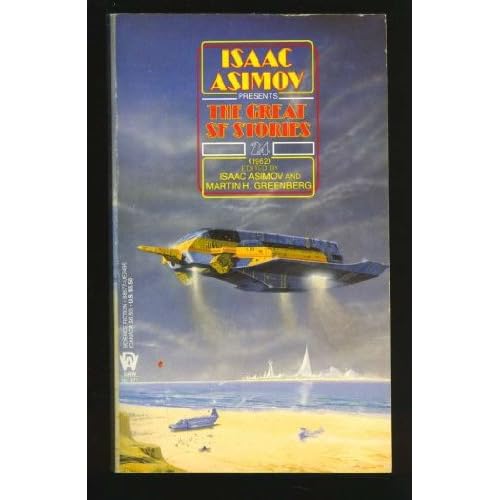
Isaac Asimov & Martin H Greenberg (Eds)' "Isaac Asimov Presents the Great SF Stories 24 (1962)" (anthology): Annotated table of contents & review

Cover image of anthology titled Isaac Asimov Presents the Great SF Stories 24 1962, edited by Isaac Asimov and Martin H GreenbergThis is #24 of a series of 25 anthologies by these editors. This book collects stories first published during the year 1962.

Where I'm aware of online copies, I provide download links. My rating is in brackets. Where I've a separate post on a the story, link on story title goes there. Link on author or publisher yields more of stories from the source.

Table of contents (13 stories, best first, unread last).

  1. [novelette] James White's "Christmas Treason" (A); F&SF, January 1962; humor: When little kids brought about global nuclear disarmament!
  2. [ss] Harry Harrison's "The Streets of Ashkelon" aka "An Alien Agony" (A); download; New Worlds Science Fiction, September 1962; religion: Religion creates sinners!
  3. [ss] Christopher Anvil's "Gadget vs Trend" (A); download; Analog, October 1962: Little Brother gets a weapon to fight the Big Brother.
  4. [novelette] Cordwainer Smith's "The Ballad of Lost C'Mell" (B); Galaxy, October 1962; politics: This society's underprivileged are fighting for civil liberties.

    It's been a while since I read it. I've a feeling US readers might see more here than I could see. Probably inspired by some episodes of US history - I'm not sure.
  5. [ss] J G Ballard's "The Insane Ones"; Amazing Stories, January 1962: Not read.
  6. [ss] R A Lafferty's "Seven-Day Terror"; If, March 1962: Not read.
  7. [novelette] Poul Anderson's "Kings Who Die"; If, March 1962: Not read.
  8. [ss] Fritz Leiber's "The Man Who Made Friends with Electricity"; F&SF, March 1962: Not read.
  9. [ss] Mark Clifton's "Hang Head, Vandal!"; Amazing Stories, April 1962: Not read.
  10. [novella] Theodore L Thomas' "The Weather Man"; Analog, June 1962: Not read.
  11. [ss] Mack Reynolds' "Earthlings Go Home!"; Rogue, August 1962: Not read.
  12. [novella] Theodore Sturgeon's "When You Care, When You Love"; F&SF, September 1962: Not read.
  13. [novelette] Gordon R Dickson's "Roofs of Silver"; F&SF, December 1962: Not read.

Fact sheet.

First published: 1992 (DAW).
Relevant entries have been added to the list of stories from John Campbell's Astounding/Analog.
Some of the bibliographical information here comes from ISFDB.
Legend: ss = short story.