Showing posts with label Nebula Award. Show all posts

Monday, July 22, 2013

John Varley's "Air Raid" (short story, doomsday, free)

I found it mostly uninteresting to wade through, & you will notice that author has consciously made it difficult for you to comprehend what is going on. But nice positive ending.

Story summary.

In a future where a deadly airborne virus has made earth uninhabitable & the few survivors immune to it have a highly withered body. But a group of these men of the future, with advanced technology including time travel, seem to be up to something nasty.

Much of the story appears to be body snatching raid of an airplane in the past, an airplane about to crash. But their intentions are honorable, as we'll discover in the end...

Fact sheet.

First published: Asimov's, Spring 1977.
Download full text from Baen eBooks.
This story was later expanded into a novel, a screenplay, & a movie, all titled "Millenium".
Nominated for Hugo Award 1978 in short story category.
Nominated for Nebula Award 1978 (or was it 1977) in short story category.

Sunday, May 26, 2013

Nebula Awards 2012: Winners announced

@SFWA.

PS: I wonder if I'm making mistakes or Blogger has started behaving in a weird way. I'd posted this several days back, but just noticed it was marked "Draft!"

Sunday, October 7, 2012

Frank Herbert's "Dune" (novel): Life on a parched desert world

Cover of the novel Dune by Frank Herbert
This was my third attempt at reading this book. I distinctly remember that on each of the two earlier occasions, I gave up within first few dozen pages -  because I found names in the story impossible to spell! This time I had no such difficulty. Only difference between then & now is: I now have some experience reading sf; then I was new to the genre. So if you are a genre novice who discovered sf relatively late in life & cannot relate to the book everyone praises, may be try it a few years down the line. This also makes me wonder if I'll still like the stories I then loved!

While the story has a couple of scenes I found very silly (a completely unnecessary knife duel near the end, a 3-4 year old supremely endowed girl happily fighting on the battlefront of a dirty war), I generally liked the book.

While there are a lot of issues this book of epic scope deals with, one of the most memorable, if macabre, part for me was: the water is so precious & scarce on this desert world of Arrakis that a part of the funeral rituals for the dead involves extracting the water from the dead body for later community use!

There are any number of summaries of this book on the net; so I'll skip that part.

Fact sheet.

First published: (as novel) 1965.
This is a fix up novel, based on author's 2 earlier works: "Dune World" (Analog, December 1963 - February 1964 in 3 parts) & "The Prophet of Dune" (Analog, January-May 1965 in 5 parts).
Rating: A. 
Winner of Hugo Award 1966 in novel category.
Winner of Nebula Award 1965 in novel category.
Among the stories from Astounding/Analog issues edited by John Campbell.
Related: Stories of Frank Herbert.

Wednesday, August 8, 2012

Ursula K Le Guin's "Nine Lives" (novelette): A feeling of loneliness

10-clones, 5 men & 5 women, all derived from the same man, act as a single individual, mutually dependent, but not noticing others. Even sex is within the group.

9 die in an earthquake. Story is of the survivor discovering life as an individual.

Collected in.

  1. David Hartwell & Kathryn Cramer (Ed)'s "The Ascent of Wonder: The Evolution of Hard SF".

Fact sheet.

First published: Playboy, November 1969.
Nominated for Nebula Award 1970 in novelette category.
Rating: B.
Related: Stories of Ursula K Le Guin.

Wednesday, May 16, 2012

Barry B Longyear's "Enemy Mine" (novella): They're only different, not evil!

This often well regarded & widely anthologized story didn't work as well for me. It does have its moments, however.

Story is of two fighter pilots from a space war between humans & Dracs - one of each crash on a harsh uninhabited world, & are thus stranded. Initial hate soon gives way to friendship that will outlast even the death of one of them, even after their rescue at the end of war & the continuing mutual antagonism of two societies even in peacetime...

Notes.

* This story "seems likely to have a source from a late 1960s screenplay, this time the 1968 John Boorman film Hell in the Pacific, which starred Lee Marvin and Toshirô Mifune as two WW2 pilots, one American and one Japanese, crashed on a Pacific island, who have to co-operate to survive."

Fact sheet.

First published: Asimov's, September 1979.
[via Bill Garthright @ClassicScienceFiction]
Rating: B. 
Winner of Hugo award 1980 in novella category.
Winner of Nebula award 1979 in novella category.
Movie of the same titled, directed by Wolfgang Petersen, is based on this story.

Tuesday, March 6, 2012

James H Schmitz's "Forget It" aka "Planet of Forgetting" (novelette, free): An unusual animal defense against predators

An intelligence agent, carrying a secret coded (paper?) file to another world, is captured by the enemy on the way. Story is of him outwitting the entire enemy ship taking him to their world. Features telepathic plants capable of moving around.

Fact sheet.

First published: Galaxy, February 1965.
Note: "this cover story was mistakenly listed as "Planet of Forge" on Galaxy's TOC."
Eric Flint on online version I've linked in download link below: 'we changed the name of the hero, did some rearranging of paragraphs in the early sections of the story, somewhat modified a few paragraphs of background material to make it fit the Hub setting, and cut a short "trick ending" that wasn't really part of the story itself and wouldn't fit the Hub setting.'
Download full text from BaenCD.
Rating: B.
Nominated for Nebula Award 1966 in novelette category.
Related: Stories of James H Schmitz.

Tuesday, February 28, 2012

Nebula Awards 2011 - short stories: Nominees & my rankings

Quote from short story Movement by Nancy Fulda
Official announcement.

Seven stories, all first published in the US during 2011. Nothing really outstanding. I found two completely unreadable; rest are at least readable.

All the ones I finished, except Yu's, are in sad mood, about various kinds of tragedies.

Where I have a separate post on a story, link on story title goes there. My rating appears in brackets. Links on author or publisher yield more matching fiction. All stories are online, & download links are included.

Nominees (7 stories, best first).

  1. Nancy Fulda's "Movement" (B); download text & audio; Asimov's, March: Life of a girl inflicted with "temporal autism".
  2. David W Goldman's "The Axiom of Choice" (B); download; New Haven Review, Winter: A personal tragedy & a man's pain coping with it. Has unusual FORTRAN-style presentation.
  3. E Lily Yu's "The Cartographer Wasps and the Anarchist Bees" (B); download text/audio; Clarkesworld, April: Wasps colonize bees territory. Imaginative but with lousy ending.
  4. Ken Liu's "The Paper Menagerie" (B); download; F&SF, March/April: Emotional & sad story of a Chinese peasant girl - losing her parents, being sold as a slave to a Hong Kong household, being sold as a "wife" to an American man, & finally being rejected by her American son who disliked his Chinese origins.
  5. Tom Crosshill's "Mama, We are Zhenya, Your Son" (B); download; Lightspeed, April: A woman has sold her 8 year old son to a scientist for experiments. Scientist who plugs him into a virtual reality environment, only we are not clear if it is virtual reality or alternate realms. Where multiple copies of child's consciousness experience multiple terrors.
  6. Adam-Troy Castro's "Her Husband's Hands" (C); download; Lightspeed, October: Left partway through. This is macabre stuff. A soldier lost all of his body except hands, which were reanimated & returned to his wife. How should the wife be interacting with these living disembodied hands?
  7. Aliette de Bodard's "Shipbirth" (C); download; Asimov's, February: Left partway through - something incomprehensible & apparently gory about future star-faring humans.

Fact sheet.

  1. Other categories in this year's Nebula awards: [novelette], [novella].
  2. This year's other awards: BSFA short fiction.
  3. Previous Nebula award nominees & winners.
  4. My "best of 2011" list.
  5. Fiction originally published during 2011.
  6. "Best of" lists.

Sunday, February 26, 2012

E Lily Yu's "The Cartographer Wasps and the Anarchist Bees" (short story, colonization, free): Wasps colonize bees!

Interesting colonization story - wasps are colonists & bees are natives whose territory they're colonizing. But resolution is by invoking deus ex machina, & that spoiled the ending for me: colonists are removed from the scene by a higher power, & rebels are killed by weather!

Fact sheet.

First published: Clarkesworld, April 2011.
Download full text/audio from publisher's site.
Rating: B.
Nominated for Nebula Award 2011 in short story category.

Saturday, February 25, 2012

David W Goldman's "The Axiom of Choice" (short story, non-genre, free): Revisiting "goto"!

The most interesting thing about this story is its unusual structure - somewhat in the form of a FORTRAN program.

Story itself is about a personal tragedy, initial inability of the victim to cope, & eventually signs that may be he's beginning to put it behind. This plot usually doesn't work for me - there are just too many stories of the kind. But I wasn't bored.

Fact sheet.

First published: New Haven Review, Winter 2011.
Download full text from publisher's site.
Rating: B.
Nominated for Nebula Award 2011 in short story category.

Wednesday, February 22, 2012

Ken Liu's "The Paper Menagerie" (short story, fantasy, free)

This may not be a bad read, provided you have a taste for emotional tearjerkers.

It's the sad story of a Chinese peasant girl - losing her parents to lawlessness during Cultural Revolution, being sold as a slave to a Hong Kong household, being sold as a "wife" to an American man, & finally being rejected by her American son who dislikes his Chinese origins.

Fact sheet.

First published: F&SF, March/April 2011.
Download full text from Random House.
Rating: B.
Nominated for Nebula Award 2011 in short story category.
Related: Stories of Ken Liu.

Monday, February 20, 2012

This year's Nebula award nominees

Thursday, February 2, 2012

Lawrence Watt-Evans' "Why I Left Harry's All-Night Hamburgers" (short story, parallel universe, free): Got a traveling itch?

This has what some Westerners describe as the "homey" feel of some of the Clifford D Simak's fiction. And nice language.

Story summary.

A diner somewhere at the edge of a small town often receives some very weird crowd late night - travelers from other parallel universes. Their talk overs the years has ignited a traveling itch in the narrator, a teenager employee of the place.

Fact sheet.

First published: Asimov's, July 1987.
Read online at Google cache.
Rating: A.
Winner of Hugo Award 1988.
Nominated for Nebula Award 1987.

Friday, January 6, 2012

3 stories of James H Schmitz

All are colorful in their own way (but "Balanced Ecology" is more colorful than others). List is in order of my preference, best first.
  1. [ss] "Balanced Ecology" (B); download; Analog, March 1965: A jungle world knows how to defend itself against greedy humans.
    Nominated for Nebula Award 1966 in short story category.
  2. [novelette] "The Winds of Time" (B); download; Analog, September 1962: A man & a woman are trapped, kidnapped, & ... harassed ... by ... aliens.
  3. [ss] "A Nice Day for Screaming" (B); download; Analog, January 1965: One of the early exploration ships in "pseudospace", a kind of parallel space, is chased by ... something.
Among the stories from Astounding/Analog issues edited by John Campbell.
Related: Stories of James H Schmitz.

Friday, October 14, 2011

Terry Bisson's "Bears Discover Fire" (short story, non-genre, free)

I don't really get what makes this story so famous. May be it touches some US specific cord, & has local appeal there.

It's not a bad story, though. A non-genre story about the life of a family with dying mother, with some interesting observations.

There is an attempt to make the clearly non-genre story genre that didn't really work for me. We're told in parts of US countryside, bears have discovered the secret of fire, & make campfires at night.

Fact sheet.

First published: Asimov's, August 1990.
Read full text at Scribd.
Rating: B.
Winner of 1991 Hugo Award in short story category.
Winner of 1990 Nebula Award in short story category.
Related: Stories of Terry Bisson.

Monday, September 19, 2011

Joe Haldeman's "None So Blind" (short story, superman, free): Redeploying the human visual cortex

This very amusing story has its technological parts premised on this: if more than a third of human brain is devoted to dealing with visual signals from the eyes, why aren't the blind people geniuses as a rule (since this much brain capacity is lying "unused" in them)?

That leads to actual technology that lets a surgeon tinker with the optic nerves to help brain rewire itself - so we get intellectual supermen off the operating table!

See also.

  1. John Wyndham's "The Day of the Triffids": Is based on the antithesis: however big a brain, without eyes, it's not much use. If most of the world were to go blind suddenly, our large brains won't save us from even small-brained menaces.

Fact sheet.

First published: Asimov's, November 1994.
Download full text from one of the author's sites. [via an anonymous visitor of Variety SF]
Rating: A.
Winner of Hugo Award 1995 in short story category.
Nominated for Nebula Award 1995 in short story category.
Related: Stories of Joe Haldeman.

Sunday, April 17, 2011

Geoffrey A Landis' "The Sultan of the Clouds" (novella, adventure, free): Ordinary man foils genocide conspiracy

Actually, you've probably read this story before; it's just umpteenth retelling of the same story. Interesting thing is: it's one of the few Nebula nominees this year in novella category that I could actually finish. There is constant action, so no boredom.

Story summary.

Dr Leah Hamakawa & David Tinkerman, because of their experience studying Martian ecology, are invited by Carlos Fernando, the heir who will own practically all of the 1000s of orbiting human habitats of Venus. Only, several habitats don't owe him allegiance, & he's hatching a genocide conspiracy that David will foil.

Fact sheet.

First published: Asimov's, September 2010.
Download full text from author's site.
Rating: B.
Nominated for Nebula Award 2010 in novella category.

Saturday, April 9, 2011

Nebula Awards 2010: Short stories - nominees & my rankings

Official nominees announcement is at SFWA.

7 stories, all first published during 2010. If you like a shocker, "Arvies" might work. Two others are at least readable - "Conditional Love" & "How Interesting: A Tiny Man". One I've not read. Rest aren't worth noting.

If I have a separate post on a story, link on story title goes there. Link on author or publisher fetches more matching fiction. All stories are online, & download links are included. My rating is in brackets.

List below is in order of my preference, best first, unread last.
  1. Adam-Troy Castro's "Arvies" (B); download; Lightspeed, August 2010: An extreme form of slavery.

    Caution: This is a very dark story, intended primarily to shock, with extreme cruelty.
  2. Harlan Ellison's "How Interesting: A Tiny Man" (B); download; Realms of Fantasy, February 2010; fanfic: Mary Shelley's "Frankenstein" retold, with a twist.
  3. Felicity Shoulders' "Conditional Love" (B); download; Asimov's, January 2010: Caring for deformed & abandoned children. Deformities introduced by parents because of their quest for genetically tweaked "perfect" babies, a process that sometimes has horrific side effects.
    Related: Judith Merril's "That Only a Mother" far more effectively addresses the same general theme.
  4. Vylar Kaftan's "I'm Alive, I Love You, I'll See You in Reno" (B); download; Lightspeed, June 2010: A love story that's a bit too science fictional for my taste.
    A man & a woman. Next door neighbors. Forever in love, never really meeting. A lot of cosmic & relativity adjectives thrown in in the descriptions. In some ways, it's just a review of many popular sf tropes.
  5. Amal El-Mohtar's "The Green Book" (C); download; Apex Magazine, 1 November 2010: Cannot make out the head or tail of it.
    There is a magical impossible-to-destroy notebook ("The Green Book") that can be used to chat with some dead - you write something, they write back! And some sort of sinister organization called "Sisters" that apparantly killed the dead you chat via the notebook & ominous implication they'll get to you too for having read their secret.
  6. Kij Johnson's "Ponies" (C); download; Tor.com, 17 November 2010: Little (or is it teenage?) girls competing for status & belonging. It's for fans of unicorns, & of unnecessary gory violence.
  7. Jennifer Pelland's "Ghosts of New York; download; Dark Faith: Not read. Going by some comments I've read about it, it has something to do with 9/11 terrorist attack in New York.

Related.

  1. Other short fiction categories of Nebula Awards 2010: [novelette], [novella].
  2. Previous Nebula Awards for short stories: 2009, 2008, 2007.
  3. All Nebula Award winners & nominees.
  4. Competing awards for "best" short stories of 2010: BSFA, [Hugo].
  5. Anthologies collecting "best" short fiction of 2010: [Dozois'], Horton's, Strahan's, Hartwell/Cramer's.
  6. Fiction originally published during 2010 (search "Rating: A" for my selections of "good" stories).
  7. My "best of 2010" list.
  8. "Best of" lists

Tuesday, March 8, 2011

Felicity Shoulders' "Conditional Love" (short story, genetic engineering, free)

This one is for readers who like emotional stories.

It's set in a hospital that cares for abandoned children. Abandoned by their parents because of their physical deformities. Physical deformities introduced in the first place by parents themselves, by genetic modifications of the unborn to create "perfect" kids - an illegal process that sometimes has horrific side effects.

Fact sheet.

First published: Asimov's, January 2010.
Download full text/audio from author's site.
Rating: B.
Nominated for Nebula Award 2010 in short story category.

Wednesday, March 2, 2011

Harlan Ellison's "How Interesting: A Tiny Man" (short story, fanfic, free): Mary Shelley's "Frankenstein" retold, with a twist

Quote from short story How Interesting, A Tiny Man by Harlan Ellison
This is, in a way, a satire on tendency of some people to poke their nose into things that are none of their business. But similarity with Shelley's "Frankenstein" is uncanny. But unlike Shelley's classic, this story doesn't have an irresponsible creator; it's the society that is the villain.

Story summary.

Narrator has created another man in a lab - a very tiny man, just 5 inches tall, but otherwise a normal man. All is well, the tiny man is welcomed everywhere ... until a woman begins spewing venom for no reason at all...

Fact sheet.

First published: Realms of Fantasy, February 2010.
Download full text from publisher's site.
Rating: B.
Nominated for Nebula Award 2010 in short story category.
Related: Stories of Harlan Ellison.

Thursday, February 24, 2011

Nebula Awards 2010: nominees announced

Link. [via QuasarDragon & SF Signal]

Includes download links for short fiction.

Related: Nebula Award fiction - nominees & winners.

Friday, January 28, 2011

Harlan Ellison's "Paladin of the Lost Hour" (novelette, fantasy, free): Two friends from different backgrounds but with a common destiny

This is one of the rare Ellison stories I liked - first 80% of it anyway, before the really fantastic elements ruined it for me.

This is one of the "lost time" stories - because a few days were dropped from Julian calender in 16th century when it became Gregorian calender. In his non-fiction article, author tells us the story idea came from the hour "lost"/"recovered" when clocks are reset in countries that have daylight saving time concept.

Interesting parts relate to accidental friendship of two lonely men, one much older than the other. Only there is something mysterious about the old man, & he's carrying a weird gadget; we'll learn the secrets in the end. Story has black man/white man undertone that will likely mean something to US readers; also has loss of someone as a major sentimental element.

Fact sheet.

First published: Terry Carr (ed)'s "Universe 15" (anthology, 1985).
Download full text from Ellison Webderland. [via ClassicScienceFiction Yahoo group].
Rating: A.
Winner of Hugo Award 1986 in novelette category.
Nominated for Nebula Award 1985 in novelette category.
Related: Stories of Harlan Ellison.

Wednesday, November 17, 2010

John Varley's "The Persistence of Vision" (novella, utopia, free): Physical misfits create a society where they're the norm

Quote from short story The Persistence of Vision by John Varley
While there are multiple themes here, a substantial part of the story is devoted to language & communications. Say no one had eyes & ears. How would you communicate?

Ending is very abrupt & arbitrary.

Caution: Story includes some sexually explicit scenes.

Story summary.

An epidemic ("German measles, or rubella") left some 5000 children born blind & deaf in its wake. Society is generally caring - in its own way, but they'll always be misfits, & objects of pity. On reaching adulthood, a few dozen of them set out to build a community custom-built for them; one where being deaf & blind is the natural state of being.

Story is the description of their commune, seen from the eyes of a drifter who'll be a drifter no more.

Quotes.

  1. "To protest, one must be aware of the possibility of something better. It helps to have a language, too."
  2. "nothing is moral always, & anything is moral under the right circumstances."
  3. "Why is it that once having decided what I must do, I'm afraid to reexamine my decision? Maybe because the original decision cost me so much that I didn't want to go through it again."

Fact sheet.

First published: F&SF, March 1978.
Download MP3 podcast of the story, read by Spider Robinson. [via Boing Boing]
Note: I've'nt personally heard this MP3; I've only read the original text version.
Rating: A.
Winner of Hugo Award 1979 in novella category.
Winner of Nebula Award 1978 in novella category.
Related: Stories of John Varley.

Thursday, September 30, 2010

Samuel R Delany's "Aye, and Gomorrah" (short story, free): Fetish of sexually normal towards sexually abnormal

This is my second or third Delany story; none have worked for me so far. May be it will work better with readers familiar with US of 1960s? In any case, it appears to be among the better known stories of author.

I've no idea how the title relates to the story.

Story summary.

Maintenance of infrastructure on moon, Mars, & the satellites of Jupiter requires "altered" people ("Spacers"), because of long exposure to radiation. This alteration kills their sexual nature - they're now neither male nor female. The operation is done when they're still kids - "children whose sexual responses are hopelessly retarded at puberty."

Among the normal are "frelks", people with a sexual fetish for spacers. And spacers often oblige, for money.

This story is a collection of vignettes about these contacts - spacers vs frelks. Narrated by an unnamed spacer, part of a group on ground holidays.

Fact sheet.

First published: Harlan Ellison (ed)'s "Dangerous Visions" (1967).
Download full text from Internet Archive.
Rating: B.
Winner of Nebula Award 1967 in short story category.
Nominated for Hugo Award 1968 in short story category.
Among the Ellen Datlow's Sci Fiction's classics.

Monday, July 12, 2010

Joanna Russ' "When It Changed" (short story, free): It's a women's world!

Author introduces the key premise of this story in a note at the end of the copies linked below: "almost all the characterological sex differences we take for granted are in fact learned and not innate."

Story summary.

Human colonized world of Whileaway had a plague 600 years ago - an event that killed all men. Only women were spared. They figured out a way of breeding, & now have a normal all-women society.

Then come four men from long forgotten earth. And we get into serious (but sometimes funny) communications issues...

See also.

  1. Alice Sheldon's "Houston, Houston, Do You Read?": Time traveling men who arrived from the past must be killed, but only after harvesting their semen, in the all women society right here on earth (men died out long ago).

Fact sheet.

First published: Harlan Ellison's "Again, Dangerous Visions" (anthology, 1972).
Download full text from Internet Archive or Scribd (both links were very slow when I checked just before posting).
Rating: B.
Winner of Nebula Award 1972 in short story category.
Nominated for Hugo Award 1973 in short story category.
Among the Ellen Datlow's Sci Fiction's Classics.

Monday, June 14, 2010

Ursula K Le Guin's "The Word For World is Forest" (novella): Natives throw out ruthless & evil colonists

Cover image of the novella The Word For World is Forest by Ursula K Le Guin
I'll put it among the essential reads of science fiction on colonialism.

In some sense, this is yet another precursor to Hollywood movie "Avatar". While Alan Dean Foster's "Midworld", often cited as the prototype after which Avatar is modeled, focuses more on world building, Le Guin's version has a more strongly demarcated conflict: human colonists ("yumens" to natives) are far more evil, natives (derisively called "creechies" by colonists) are able to repel them by themselves - making the reader root more strongly for the natives.

Story summary.

Colonists from earth want wood from the forest world of Athshe ("New Tahiti" to colonists). So they set about razing the local forests, destroying native cities & villages inside the
forest. There is general genocide of natives, taking some as slaves, routine rapes of their
women.

Natives finally wake up via the hero, Selver. He & his wife were taken slave, his wife
raped & killed by Captain Don Davidson - official villain & personification of the ultimate evil. From this point on, the days of humans on this world are numbered, with Selver organizing & leading the local military raids against colonist camps.

Another individual that is sketched in some detail is colonists' anthropologist, Captain Raj Lyubov - the "good" human.

Quotes.

  1. "The world is always new, however old its roots."
  2. "For four years they've behaved to us as they do to one another. Despite the physical differences, they recognized us as members of their species, as men. However, we have not responded as members of their species should respond... We have killed, raped, dispersed, & enslaved the native humans, destroyed their communities, and & down their forests. It wouldn't be surprising if they'd decided that we are not human."

    "And therefore can be killed, like animals".
  3. "The Athshean word for world is also the word for forest."
    "Athshe, which meant the Forest, & the World."

    This is where the title comes from.

Fact sheet.

First published: Harlan Ellison (ed)'s "Again, Dangerous Visions" (anthology, 1972).
Rating: A.
Winner of Hugo award 1973 in novella category.
Nominated for Nebula Award 1972 in novella category.
Related: Stories of Ursula K Le Guin.

Sunday, May 16, 2010

Nebula Awards 2009: Winners announced

Official announcement & complete list.

  1. [novel] Paolo Bacigalupi's "The Windup Girl"; download.
  2. [novella] Kage Baker's "The Women of Nell Gwynne’s"; all nominees.
  3. [novelette] Eugie Foster's "Sinner, Baker, Fabulist, Priest; Red Mask, Black Mask, Gentleman, Beast"; download text/audio; all nominees.
  4. [ss] Kij Johnson's "Spar"; download text/audio; all nominees.

Friday, April 2, 2010

Nebula Awards 2009 - novellas: Nominees

Official announcement & opening remarks.

I'd written this post sometime back, hoping to actually read some of the stories - so I can fill in their descriptions before posting. But going by my experience reading this year's novelette & short story nominees, I'm not feeling inclined. Posting this anyway for download links, in case someone wants to give them a try.

PS: I'd actually began reading Kress' story quite sometime back. Have read only a few initial pages - something about terrorism.

Nominees (6 stories, best first, unread last).

If I have a separate post on a story, link on story title goes there. For read stories, my rating (ABC: A = worth the time, C = don't bother) is in brackets. Links on author or publisher fetch more fiction from source.
  1. Carolyn Ives Gilman's "Arkfall" (A); download or read online; F&SF, September 2008: Adventure in an exotic waterworld.

    Added to my "best of the year 2008" list.

    Note the official SFWA list wrongly labels it as first published in September 2009; it's 2008.
  2. [winner] Kage Baker's "The Women of Nell Gwynne's"; Subterranean Press, June 2009: Not read.
  3. Nancy Kress' "Act One"; download; Asimov's, March 2009: Not read.
  4. James Morrow's "Shambling Towards Hiroshima"; Tachyon, February 2009: Not read.
  5. Jason Sanford's "Sublimation Angels"; download; Interzone, October 2009: Not read.

    Interzone? Is any work published by an SFWA member anywhere in the world eligible? I used to think Nebulas were for work published in the US.
  6. John Scalzi's "The God Engines"; Subterranean Press, December 2009: Not read.

Related.

  1. Other short fiction categories in this year's Nebula awards: short stories, novelettes.
  2. Last year's Nebula awards: short stories, novelettes, novellas.
  3. Competing awards that recognize "best" fiction originally published in 2009: Aurialis (Australian authors), BSFA (fiction published in UK), Million Writers (global, online short fiction).

    Note the scope of Nebulas is 1.5 years - later half of 2008 & all of 2009. All other awards only care about 2009.
  4. Anthologies that collect "best fiction originally published during 2009": Dozois', Hartwell/Cramer's, Horton's, Strahan's.
  5. My "best fiction originally published during 2009, 2010" lists (also list others' best of relevant year lists at bottom).
  6. "Best of" lists.
  7. Fiction originally published in 2008/2009, during 2000s.
Note: I normally update list posts like this when I read a story, find new links, etc. This post was last updated 2 April 2010.

Saturday, March 13, 2010

Nebula Awards 2009 - short stories: Nominees & my ranking

Official announcement & opening remarks.

I've read 5 of the 6 nominees. All minor ones, though "Bridesicle" stands out within the group. Two other stories that might be of some interest depending on inclination & mood:

  1. Ahmed's has beautiful language that carries it through first half; later half will likely appeal only to readers interested in magical beasts. It's Arabesque descriptions sounded sort of cliched to me, however.
  2. Jemisin's. We all have some bad days - like, often during monsoon, rain starts exactly as I'm leaving for office, & seems to change time if I change mine! This is the story of a girl in New York who's permanently having a bad day. Or rather, the fear that it's a bad day.

Nominees (6 stories, best first, unread last).

Where I'm aware of an online copy, I include download link too. If I have a separate post on a story, link on story title goes there. For read stories, my rating is in brackets. Links on author or publisher fetch more fiction from source.
  1. Will McIntosh's "Bridesicle" (B); download text/audio; Asimov's, January 2009; zombie: A woman is given a choice - die, or entice a rich man enough to make him agree to marry you! How do you expect her to behave?
  2. Saladin Ahmed's "Hooves and the Hovel of Abdel Jameela" (B); download; Mike Allen (ed)'s "Clockwork Phoenix 2" (anthology), Norilana Books, July 2009; fantasy: Narrator, a "physicker" (medical doctor), gets a house call - a woman is very sick, & needs urgent help. Physicker will end up giving help, but for something he never dreamt of.

    Beautiful language & very good first half. Second half will probably appeal better to someone with a taste in magical creatures.
  3. James Patrick Kelly's "Going Deep" (C); download; Asimov's, June 2009: Mariska, a teenager clone of a woman spacer, isn't happy with the destiny she was born for - to travel hibernating to far away stars as a pioneer.

    Readers who prefer jargon-filled stories will probably like it more than I did. It's set on moon. Not unreadable, but I generally found it not very engaging.
  4. N K Jemisin's "Non-Zero Probabilities" (C); download text/audio; Clarkesworld, November 2009; non-genre: A girl in New York city is worried over improbable accidents that happen in the city with regularity, like a train coach derailing or she being hit by debris accidentally sent flying in a park, ...
  5. [winner] Kij Johnson's "Spar" (C); download text/audio; Clarkesworld, October 2009: A woman is stuck with an alien aboard an alien lifeboat - after their ships collided head on, an event that killed her male partner! Now she's constantly having sex with the alien, & nightmares.
  6. Michael A Burstein's "I Remember the Future"; I Remember the Future, Apex Publications, November 2008: Not read.

Related.

  1. Other short fiction categories in this year's Nebula awards: novelettes, [novellas].
  2. Last year's Nebula awards: short stories, novelettes, novellas.
  3. Competing awards that recognize "best" fiction originally published in 2009: Aurialis (Australian authors), BSFA (fiction published in UK), Million Writers (global, online short fiction).

    Note the scope of Nebulas is 1.5 years - later half of 2008 & all of 2009. All other awards only care about 2009.
  4. Anthologies that collect "best fiction originally published during 2009": Dozois', Hartwell/Cramer's, Horton's, Strahan's.
  5. My "best fiction originally published during 2009, 2010" lists (also list others' best of relevant year lists at bottom).
  6. "Best of" lists.
  7. Fiction originally published in 2008/2009, during 2000s.
Note: I normally update list posts like this when I read a story, find new links, etc. This post was last updated 13 March 2010.

Sunday, February 28, 2010

Free fiction: Asimov's Nebula Award 2009 nominees

Links near top right of their home page. For most stories, text as well as MP3 audio is online.

Related: Fiction from Asimov's.

Saturday, February 27, 2010

Nebula Awards 2009 - novelettes: Nominees & my ranking

Official announcement & my opening remarks.

I gave up 3 of the 6 stories part way through. May be I'm growing impatient with stories that don't engage.

"Tragic" seems to be a common theme: one of the stories is about a major tragedy in author's personal life, another retells a Greek tragedy from an alternate perspective, third is about the tragedy of being old & sick. Even Bacigalupi's generally readable story contains elements of a tragedy, from a Western point of view, of being born in Vietnam.

If you are looking for a story that doesn't leave you in a worse mood than the one you started out with, "Divining Light" is about the only choice. But this is hard sf, & expects about 10+2 level Physics background - so it's not for everyone. On second thoughts, probably Bacigalupi's too won't leave in bad mood either, but it didn't work as well for me.

Nominees (6 stories, best first, unread last).

Where I'm aware of an online copy, I include download link too. If I have a separate post on a story, link on story title goes there. For read stories, my rating (ABC: A = worth the time, C = don't bother) is in brackets. Links on author or publisher fetch more fiction from source.
  1. Ted Kosmatka's "Divining Light" (A); download; Asimov's, August 2008; hard sf: Who else, besides humans, is special in god's scheme of things?

    Note the interesting bits are in second half. First half is quite ordinary.

    Caution: Download link above has recently been behaving erratically - sometimes fetching the file, other times giving 404. Sometimes it seems to work via this alternate longer version that resolves to same link above. File is hosted at author's site; so you might want to complain to him if neither doesn't work.

    Update 2 March 2010: Two more download links are now available at Asimov's site: text/podcast.
  2. Rachel Swirsky's "A Memory of Wind" (A); download; tor.com, November 2009: An innocent girl is murdered by her own father - as a sacrifice to please a god! A variation of a Greek legend.
  3. Paolo Bacigalupi's "The Gambler" (B); download; Lou Anders (Ed)'s "Fast Forward 2", Pyr Books, October 2008: A Vietnamese immigrant to US is working for a near-future newsroom, & is not quite cut out for the job.
  4. Michael Bishop's "Vinegar Peace, or the Wrong-Way Used-Adult Orphanage" (C); download text/audio; Asimov's, July 2008: Gave up within a couple of pages. A woman is forcibly taken to the "Vinegar Peace", an "orphanage" for people whose children have died in some sort of war.

    I later learned, at StarShipSofa audio download link above, that this story grew out of a major personal tragedy in author's life - loss of a son in a school shootout. Which probably will make me pick it up again sometime later to give a more sympathetic reading; it certainly is not for those seeking entertainment.
  5. Richard Bowes' "I Needs Must Part, The Policeman Said" (C); download; F&SF, December 2009: Cannot make out the head or tail of it. Gave up may be a third of the way through.

    A 60 year old very sick man is having strange dreams & visits from a cop!

    May be later parts of the story will reveal something profound, but I don't have patience. Nothing engaging so far.
  6. [winner] Eugie Foster's "Sinner, Baker, Fabulist, Priest; Red Mask, Black Mask, Gentleman, Beast" (C); download; Interzone, #220 (February 2009): I once tried reading it - gave up part way through. Beginning looked like something inspired by Jack Vance's funny "The Moon Moth" - a society where it's impolite to meet someone without wearing a mask. But it's nothing like Vance's classic, & I got quickly bored.

Related.

  1. Other short fiction categories in this year's Nebula awards: short stories, [novellas].
  2. Last year's Nebula awards: short stories, novelettes, novellas.
  3. Competing awards that recognize "best" fiction originally published in 2009: Aurialis (Australian authors), BSFA (fiction published in UK), Million Writers (global, online short fiction).

    Note the scope of Nebulas is 1.5 years - later half of 2008 & all of 2009. All other awards only care about 2009.
  4. Anthologies that collect "best fiction originally published during 2009": Dozois', Hartwell/Cramer's, Horton's, Strahan's.
  5. My "best fiction originally published during 2009, 2010" lists (also list others' best of relevant year lists at bottom).
  6. "Best of" lists.
  7. Fiction originally published in 2008/2009, during 2000s.
Note: I normally update list posts like this when I read a story, find new links, etc. This post was last updated 2 March 2010.

Wednesday, February 24, 2010

Free fiction: F&SF's two Nebula 2009 nominees

  1. [novella] Carolyn Ives Gilman's excellent under water adventure "Arkfall" (download) has been available elsewhere for reading online for almost a year now; now it's also available as can-save-to-local-disk HTML from F&SF.
  2. [novelette] Richard Bowes' "I Needs Must Part, the Policeman Said" (download): I gave it up within first 15% - a sick old man is having strange dreams.
[via Gordon Van Gelder]

Monday, February 22, 2010

Rachel Swirsky's "A Memory of Wind" (novelette, feminist dystopia, free): An innocent girl is killed by her monster of a father

Illustration by Sam Weber accompany the story A Memory of Wind by Rachel Swirsky at tor.com Sometimes very moving story of a young girl, sacrificed to please a god in the hope of getting a boon, by her own father - after luring her to sacrificial grounds by promise of her marriage.

Thing I didn't like about it was: it sounded like cruelty fetish. Early in the story, we know she's going to be killed by her dad; story is narrated by her spirit. Why drag us through the horror throughout the story? In fact, the girl herself & her mother knows she's about to be killed long before the story ends; we go through their detailed reactions awaiting her execution!

Two audiences will likely read more into this story than I could:

  1. Readers familiar with ancient Greece. That's where this story is set.
  2. Women. This is essentially a feminist dystopia - world seen from the eyes of a woman, a world whose rules are made by & for men, according to story's thesis.

Fact sheet.

First published: tor.com, 4 November 2009.
Download full text from publisher's site (note the online version is spread across 17 pages. Compressed HTML from download option in sidebar makes more convenient reading.)
Rating: A.
Nominated for Nebula Award 2009 in novelette category.
Related: Stories of Rachel Swirsky.

Saturday, February 20, 2010

This year's Nebula award nominees announced

Official announcement at SFWA.

Awards are in multiple categories, & for works published in the US during 1.5 years ending December 2009. I'll might have separate posts on short fiction categories later in the day.

This appears to be a more interesting list than last year in that there are relatively few entries from 2008 (except in novelette category) - last year was pretty much everything from 2007 rather than 2008!

While I've read a few stories from the list, I can name two good ones here - but both from 2008! Ted Kosmatka's "Divining Light", & Carolyn Ives Gilman's "Arkfall" (read online). Lists also include at least one story I gave up within the first 15%.

In short fiction & young adult categories, the official announcement includes some links to online copies too.

Related: Nebula awards; my "best of 2009" list (includes links to others' "best of 2009" lists too at bottom).

Monday, February 1, 2010

R A Lafferty's "Slow Tuesday Night" (short story, humor, free)

Quote from short story Slow Tuesday Night by R A LaffertyWhat if we were speeded up a lot - so you could found a company, become a billionaire, & finally go bankrupt all in may be 2 hours! A world where everyone is ... kind of ... a superman. Many episodes brought me smiles.

I got a feeling it's probably social commentary on US of its times - 1960s. Readers familiar with those issues will likely read more here. For others, it's just a lighthearted satire on fast life.

See also.

  1. I recall at least one story, probably by Ted Kosmakta or may be in one of the "Isaac Asimov Presents Great SF Stories" books, where humans slow down instead, to the speed of plants - so humans & plants can literally fight each other! I'll fill in the title here if I can remember; I'm not able to recollect it right now.
  2. At idea level, there is a parallel with relative evolution of created beings vs their creators. E.g., Theodore Sturgeon's "Microcosmic God" (download comic book adaptation), Greg Egan's "Crystal Nights" (download), & Paul Carlson's "Mirror Girl" (download).

Fact sheet.

First published: Galaxy, April 1965.
Download full text from Internet Archive, or briarpig. Or read online at Google Books (see note below)
Update: I just noticed Google Books link no longer works! Am keeping it in the hope it will still work at least in some countries, as a lot of Google Books content does. It did work here in India when I originally put it.
Rating: B.
Nominated for Nebula Award 1966 in short story category.
Among the Classics of Ellen Datlow's SciFiction.

Monday, November 16, 2009

Nebula Awards 2009 nominations: Running tally

Link. [via Jason Sanford]

List tells us which stories are currently nominated & how many votes have they got. Nominations have just opened & will be open for months - so this list will likely change drastically in days to come.

Note: Only stories published in the US qualify. And with these publication date constraints:

  1. Published during 2009.
  2. Published during later half of 2008, except that some stories meeting this criterion disqualify.
Caution: My personal experience with Nebula Award nominations during the last couple of years has been very bad: it tends to be mostly "I'll scratch your back, you please do mine" list, & with very few really good stories. May be the best days of Nebula Award are all in remote past & they're running on inertia now; or, hopefully, with change of nomination rules that begin applying from current cycle, they may yet become something worth looking out for. Time will tell.

Related.

  1. Nebula Award stories.
  2. Nebula Awards 2008 stories: short stories, novelettes, novellas.
  3. "best of" lists.
  4. My "best of 2009" list (includes links to others' "best of 2009" lists at bottom).

Friday, September 18, 2009

Alice Sheldon's "Love is the Plan the Plan is Death" (as by James Tiptree, Jr) (short story, free): Fighting instincts can be fatal

A species of animals, physically alien but with sexual & reproductive behavior similar to many familiar animals. "Plan" in the title is a substitute for "instinct"; story is of an individual's futile fight against the instinct.

Story summary.

Told from the point of view of Moggadeet, a "male" of the species that hibernate in winter.

Born in winter, chased away with his litter by mother at the end of winter as the litter changed fur color from golden (babies) to black (males) & red (females).

His first summer alone. Instinct that takes him go to caves for hibernation at the beginning of winter. His meeting the "Old One" who instructs him on his species instincts, & whom he will eat for food in winter.

His second summer & coming of age. His killing of his brother Frim for the jointly coveted lady love, Lilliloo. His instinct to keep his lady love bound up in silks his body secretes & his loving care of her. Suspecting he will kill her for food in winter, he begins gathering food - so there will be plenty for both in winter.

Coming of winter & his sexual arousal, & finally impregnation of Lilliloo. Fighting instinct & against protests of Lilliloo, his releasing of her from silken bonds. Only she now is too big, & has the instinct to eat her male partner!

Fact sheet.

First published: Stephen Goldin (Ed)'s "The Alien Condition" (anthology, 1973).
Rating: A.
Download full text from Internet Archive.
Included in Classics section of Ellen Datlow's SciFiction.
Nebula Award 1973 winner in short story category.
Hugo Award 1974 nominee in novelette (?) category.
Related: Stories of Alice Sheldon (as by James Tiptree, Jr).award

Tuesday, June 30, 2009

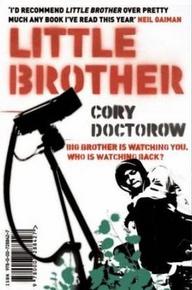
Cory Doctorow's "Little Brother" (novel, revolution, free): Anti-terror cops run amok

Cover image of the 2008 novel titled Little Brother by Cory DoctorowThere are at least 3 parts to this novel: main story, propaganda, & an overview of the currently available computer privacy technology.

Main story is common enough, but very well told: A teenager in San Francisco is among the many innocents brutally abused by US anti-terror police. He leads a revolution that promises to fix things by the end of the story.

I guess I could identify with the story because of parallels with what I've read of Indira Gandhi's notorious "Emergency" in India during 1975-1977.

Caution: Main story sometimes runs along tracks that will befuddle readers in many countries. E.g., I found nothing to connect with in the sequence that runs several pages & describes teenagers vampire games at some sort of school camp; it was just bloat, though a variation is used later during a political protest.

Propaganda is interwoven throughout the story, & occasionally goes on totally irrelevant tracks. I recall at least one occasion where the author launches into a criticism of British government's citizen tracking systems in an utterly irrelevant context.

Computer privacy technology overview is generally good, but then I'm a programmer & the stuff was generally familiar. Readers from other backgrounds might see these as info dumps.

Caution: Author doesn't always include the all important caveats with privacy technology he advocates (e.g., using TOR to connect to a site that requires a password & communicates the password unencrypted is usually worse than not using it; or that Windows version of TOR might sometimes make you think you are anonymous when you are not). Also there is very good reason much of this tech is not in widespread use - using a lot of it requires the outlook of a computer nerd, & sometimes even that is not enough. But they all have their uses - in specific contexts.

Fact sheet.

First published: 2008.
Rating: A.
Download full text in multiple formats from author's site.
Nominated for Hugo Award 2009 in novel category.
Nominated for Nebula Award 2009 in novel category.
Related: Stories of Cory Doctorow; revolution in fiction

Thursday, May 21, 2009

John Varley's "Press Enter _" (novella, AI): Lifestyle of a computer hacker & criminal

Quote from short story titled Press Enter_ by John VarleyVarley seems to specialize in horror that is accessible to people who don't have a taste for the gory! How many other authors can write almost fun stories that are clearly horror?

Caution: This story has some sex scenes.

Story summary.

Charles Kluge, a recluse, appears to have committed suicide & left his property to Victor Apfel, a neighbor (& the narrator) he barely knew. Forensic investigation of the vast computer installations at his home will reveal the lifestyle of a super-programmer & a super-criminal.

Through the investigation, we'll see two more apparent suicides: of Detective Osborne, the cop investigating the case, & Lisa Foo, the woman doing the forensic investigation of Charles' machines & software. And Victor will be left an absolutely frightened & broken man.

You see, while having his hacking fun, Charles had stumbled upon a piece of software running on NSA's computers. We never learn the true nature of this software beast, but get enough indications that it's an AI run amok, that it exists without the knowledge of NSA, & that it is the real murderer of the 3!

Fact sheet.

First published: Asimov's, May 1984.
Rating: A.
Winner of Hugo Award 1985 in novella category.
Nominated for Nebula Award 1984 in novella category.
Related: Stories of John Varley.