Showing posts with label 1946. Show all posts

Friday, October 25, 2013

Henry Kuttner & C L Moore's "The Dark Angel" (short story, superman, free)

Illustration accompanying the original publication in Startling Stories of short story The Dark Angel by Henry Kuttner and C L Moore. Image shows the superwoman animating a doll to test her newly discovered supernatural abilities when her husband spied it.What happens when one member of a couple is a prodigy? In this case, the wife is superhuman - first of the new species of homo superior. Story is about the reactions of the couple to this realization.

Fact sheet.

First published: Startling Stories, March 1946.
Read online at UNZ: part 1 & part 2.
Note: Story begins several pages down on part 1; last page of part 1 is the same as first page of part 2.
Rating: B.
Related: Stories of Henry Kuttner, C L Moore.

Saturday, August 4, 2012

K W Lessing's "Meihem in ce Klasrum" (as by Dolton Edwards) (satire, linguistics, free)

This is not really fiction, but one of those non-fact articles that Astounding sometimes published.

It describes a funny plan to turn written English into a phonetic language. Curious title is "Mayhem in the Classroom" in this evolved English.

Collected in.

  1. John W Campbell, Jr (ed)'s "The Astounding Science Fiction Anthology".

Fact sheet.

First published: Astounding, September 1946.
Download full text from Tim's page.
Rating: A.
Among the stories edited by John Campbell for Astounding/Analog.

Thursday, May 27, 2010

Henry Kuttner's "What Hath Me" (novelette, adventure, free): Good & evil posthumans fight, using a man as tool

A cocktail of many much-hashed themes here, & while not entirely unreadable, I'll put it among the most meaningless pieces from Kuttner.

Story summary.

1000 years ago, evolution speeded up for 7 humans - a step that magically transformed them into posthumans millions of years in advance of normal humanity. They became the source of Norse legends - "Aesir", & "John Starr and Lorna". We also see a related legend of "Asgard" "where the Aesir lived and ruled the worlds of Man".

Two of these posthumans are "good" - John Starr & Lorna, collectively called "Protectors". Other 5 are evil; they're Aesir - a species of their own. Aesir live on an artificial world in Asteroid belt called Asgard, & frequently take sacrifices - humans, Venusians, Martians, ... - apart from ultimately ruling these worlds via puppet native rulers.

Protectors have been trying to destroy Aesir through centuries, without success. Now using Derek Stuart as a tool, they'll succeed in their mission.

See also.

  1. E E "doc" Smith's "Lensman" series. Aesir & Protectors sounded a lot like Eddorians & Assyrians.
  2. Henry Kuttner's "The Creature from Beyond Infinity": Another story where evolution suddenly speeds up greatly for some people.
  3. Aesir "feed" on their victim's intangible "human warmth" - another trope that has been used in many stories. See, e.g., Eric Frank Russell's "Sinister Barrier", & C L Moore's "Shambleau" (download) & "Black Thirst" (in the last one, the evil aliens "eat" the "beauty" of victim girls!)
  4. We meet some of the agents of Aesir, as well sometimes Aesir themselves, where their manifestation is as a luminosity or "star lights" - a not uncommon rendition for advanced aliens in fiction. One of the most famous story of this kind is Abraham Merritt's "The Moon Pool" (download); less well known are Eric Frank Russell's "Hobbyist" & Kono Tensei's "Hikari" (included in this collection).

Fact sheet.

First published: Planet Stories, Spring 1946.
Download full text from Internet Archive or this unnamed site.
Rating: C.
Related: Stories of Henry Kuttner.

Wednesday, April 21, 2010

Samuel Mines' "Find the Sculptor" (short story, time travel, free): A time travel paradox

Illustration accompanying the short story Find the Sculptor by Samuel Mines in 1953 anthology Wonder Story Annual, Vol 2 No 1, edited by Samuel MinesFor me, the only thing that made this rather ordinary story noticeable was that it's the oldest story I've seen so far that discusses the idea that time travelers need to account for earth's movement through space too. Another more recent story that is actually built around this idea is Gavin Raine's "The Time Traveler" (2008).

Story summary.

Professor Marc Conrad who's a hero in future travels there & brings back a very old bronze statue of his own head in a park there as proof he traveled there, but dies in the process.

Six months from original time, there is the brand new monument with bronze head. But the the bronze head they've put there is the one he'd brought back from future! Who then created the head? Where is the sculptor?

Collected in.

  1. Samuel Mines (ed)'s "Wonder Story Annual, Vol 2 No 1 (1953 Edition)".

Fact sheet.

First published: Thrilling Wonder Stories, Spring 1946.
Download full text as part of a larger package.
Rating: B.
Related: Time travel fiction.

Wednesday, April 7, 2010

Henry Kuttner & C L Moore's "This is the House" (as by Lawrence O'Donnell) (novelette, haunted house, free)

Quote from short story This is the House by Henry Kuttner and C L Moore, writing under their joint pseudonym Lawrence O DonnellThere are a lot of familiar themes here - I'm not sure which of them this story originated, & which it just used. But a very good read. Sort of ... spooky version of authors' "The Twonky" (download).

This also must be among the earliest stories about nano-tech.

Story summary.

Bob Melton, his wife Michaela, & his brother-in-law Phil, have recently moved into a new house. Only, they've been having weird experiences:
  1. "Red ice" in the refrigerator.
  2. Coal furnace in the basement that burns without consuming coals!
  3. Weird noises barely registering with consciousness.
  4. Occasional feeling of complete disorientation; when normalcy returns, a lot of time seems to have passed.
  5. Windows that sometimes refuse to open; other times yield easily.
  6. Door bell that Bob doesn't hear, but Michaela can feel (though not hear)!
  7. ... it goes on & on.
As the story unfolds, we will learn that the previous owner, John French, was probably not human at all. And he seems to have done some "renovating" inside the house for his own comfort, without affecting the house's exterior...

Quotes.

  1. "The previous tenant probably rewired the house."

    "Who was he? Einstein? Or a Martian?"
  2. "Machines can be so simple they're unrecognizable."
  3. "Machines in the walls".

    "Very simple and very complicated. And unrecognizable. Paint is just paint, but you can do a Mona Lisa with it."

    "So French coated the inside walls with paint that acts like a machine?"

    "Invisible and intangible—how should I know? As for those noises at night—"

    "Well?"

    "I think the house is just recharging itself".
  4. "Eventually the world of the future—I think—won't be burdened with immense, complicated gadgets. Everything will be so simple—or seem so simple—that a man from the twentieth century might find it quite homelike, except for the results."
  5. Psychiatrist: "Half of my patients are slightly nuts, and, as long as they don't know it, they get along fine."
  6. On effect of environment on human psyche: "Lock a kid up in a dark closet, and he's apt to be afraid of the dark ever after."
  7. "If you had to move into a Ubangi hut and stay there. You wouldn't have anything in common with the natives, would you?"

    "What would you do?"

    "Change the huts a bit. Especially if I wanted to pretend I was a Ubangi, too. I wouldn't alter it outside, but I'd fix it up a bit inside, for my own convenience, and I wouldn't let anybody else come in. Chairs instead of grass mats. I wonder how French had this place furnished."

    ...

    "Why would a white man live in a Ubangi village? To study ethnology or entomology, perhaps. Or for the climate. Or simply to rest—to hibernate."

See also.

  1. Ray Bradbury's "There Will Come Soft Rains" (download): One of the best known stories featuring an automated live house that keeps on serving long after the original tenants are gone.
  2. Clifford D Simak's "The Big Front Yard": Well known story where the aliens quietly renovate the house, no need to ask permission of its human owner... And the resulting house becoming something else altogether!
  3. Larry Niven's "Wait It Out": A hibernating man - alive but time seems to be moving rather slowly...

Fact sheet.

First published: Astounding, February 1946.
Download full text.
Rating: A.
Among the stories from Astounding/Analog issues edited by John W Campbell, Jr.

Related.

  1. Stories of Henry Kuttner, C L Moore (as by Lawrence O'Donnell).
  2. Tuesday Classics;
  3. Fiction from 1940s.

Friday, March 19, 2010

Free fiction: A year's worth of "Weird Tales"

Scans in 12 issues in CBR format in 6 RAR files at Crosseyed Cyclops. Two Canadian editions; all others are apparently US editions.

I'd actually downloaded them a couple of months back, but forgot posting.

Note RAR files are generally large - about 150 MB for most files, though a couple of them are smaller. Can be downloading only one file at a time, & must manually download - there is a no-robot verification step. Means some human time will be needed.

  1. "Weird Tales 1 rar": May 1950, November 1952. Among the authors: Robert Bloch.
  2. "Weird Tales 2 rar": October 1936, October 1937. Among the authors: Robert Bloch, C L Moore, Robert E Howard, Henry Kuttner, Arthur Conan Doyle, H P Lovecraft, Edmond Hamilton.
  3. "Weird Tales 3 rar": December 1937, March 1938. Among the authors: Robert Bloch, Edmond Hamilton, Robert E Howard, H P Lovecraft, Jack Williamson, Henry Kuttner.
  4. "Weird Tales 4 rar": July 1938, November 1941. Among the authors: Henry Kuttner, H P Lovecraft, Edmond Hamilton, Clark Ashton Smith, Paul Ernst, Robert Bloch, Robert E Howard.
  5. "Weird Tales 5 rar": September 1945 (Canadian Edition), July 1944. Among the authors: Robert Bloch, P Schuyler Miller, Ray Bradbury, Edmond Hamilton.
  6. "Weird Tales 6 rar": January 1946 (Canadian Edition), May 1947. Among the authors: Edmond Hamilton, Robert Bloch, Eric Frank Russell, Theodore Sturgeon.
Related: Fiction from Weird Tales; old pulps.

Friday, February 26, 2010

"Famous Fantastic Mysteries", Vol 8 No 2 (December 1946) (magazine, free): Annotated table of contents

Cover image by Finlay of Famous Fantastic Mysteries magazine, December 1946 issueAvailable online at Internet Archive in multiple formats.

Table of contents.

  1. [novel] [reprint] Francis Sibson's "Unthinkable": "An outcast ship on a lost horizon, she sailed toward her strange rendezvous with the dead—the ghost vessel which had fought back from the legends of the past—to find no world left to hear her story!"
  2. [ss] [reprint] E F Benson's "At the Farmhouse": "Carefully he planned his perfect crime, so no trace of tangible evidence could possibly remain. That the flaw might be intangible never entered his mind..."
  3. [ss] A Bertram Chandler's "And Not in Peace" (as by George Whitley): "He laughed at devils and vampires and wasn't afraid, because they belonged to the world of fantasy—forgetting that it is sometimes the realest world of all..."

Notes.

  1. While the cover of the linked online issue & at ISFDB have same picture, text differs. Online version lists 3 editors on cover, ISFDB none on cover but one from other sources!
  2. Cover image in this post is taken from ISFDB, because attempt to extract it from my downloaded PDF makes Acrobat hang!
Related: Pulps, fiction from 1940s.

Thursday, January 14, 2010

Henry Kuttner & C L Moore's "Time Enough" (as by Lewis Padgett) (short story, immortality, free): Sometimes the best argument is a demonstration

Quote from short story titled Time Enough by Henry Kuttner and C L Moore, writing under their joint pseudonym Lewis PadgettParts of it feel like Mary Shelley's "The Mortal Immortal" (download).

Story summary.

A nuclear catastrophe destroyed most human culture & artifacts. Among the human survivors were a few people with a mutation - they were practically immortal. Immortal, but aging in a natural way - so senility, bodily troubles, etc are norm among them.

Now, 500 years down, a new human civilization has arisen. With "Old 'Uns" isolated by the government to avoid envy among the normals.

But Sam Dyson, working with radiation in a lab, has figured out a way to achieve immortality. How do the powers-that-be convince him to give it up? Well - they do have an effective argument, but it doesn't involve speaking...

Fact sheet.

First published: Astounding, December 1946.
Download full text.
Rating: B.
Listed among the stories from John Campbell's Astounding/Analog.
Related: Stories of Henry Kuttner, C L Moore (as by Lewis Padgett); Stories involving immortality; Mutants in fiction.

Tuesday, December 29, 2009

Henry Kuttner's "Call Him DEMON" (novelette, haunted house, free): Little child "beats" the ghost

Illustration accompanying the short story Call Him DEMON by Henry Kuttner in 1953 anthology titled Wonder Story Annual, Vol 2 No 1, edited by Samuel MinesKuttner is back here with his favorite subject - children can see things & think in ways that makes them aliens so far as adults are concerned; younger the children, more alien their psychology.

Story summary.

The house with Grandmother Keaton, Aunt Bessie, & 4 uncles - Simon, James, Lew, Bert. Plus 5 children - Jane Larkin (9), from whose point of view the story is told, & Beatrice, Charles, Emily, & Bobby (youngest).

And the "Wrong Uncle" - uncle with whom adults see nothing wrong but kids do (older kids are afraid of him; younger ones don't know fear). Uncle who came 3 weeks back from god knows where & modified the minds of adults to think he had always been around. Uncle who comprises of two parts - a human shaped one here, & an indescribable one that kids can sense after crossing some sort of multi-dimensional portal in the cellar. Uncle whose presence in the house is wearing down the grown-ups for reasons they cannot place.

Uncle who must be fed red raw meat regularly to avoid bad things from happening. Since only kids can sense him (it), they do what they can.

And a very Kuttnerish climax, where the youngest child Bobby is trying to outsmart the demon & "win" the game. And we will see the dreadful meaning of "win" - a meaning the child doesn't realize.

Notes.

"Demon" of title is used in two senses - the cross-dimensional alien haunting the place, & the youngest child Bobby whose behavior would be as alien to grown-ups...

See also.

  1. Henry Kuttner & C L Moore's "Mimsy Were the Borogoves" (download): Another story with somewhat similar adult/child mental alienation theme.
  2. "Makdee" (2002); movie description at IMDB: Another story with a haunted house, & a little girl who must regularly feed meat to the witch living there because...

    Original is a Hindi movie; I don't know if an English dubbed version is a available.
  3. Philip K Dick's "The Father-Thing"; read online (no download, need a lot of clicks; is it a novelization? I'd read the original short story version): Similar situation - an alien impostor has conned mom into believing he's dad, but it cannot fool the kid.

Collected in.

  1. Samuel Mines (ed)'s "Wonder Story Annual, Vol 2 No 1 (1953 Edition)".

Fact sheet.

First published: Thrilling Wonder Stories, Fall 1946.
Download full text as HTML, or as part of the online scans of this anthology.
Rating: A.
Related: Stories of Henry Kuttner; Ghost stories.

Tuesday, November 10, 2009

A E van Vogt's "Empire of the Atom" (collection, free): Annotated table of contents & review

Cover image of the short story collection titled Empire of the Atom by A E van Vogt. Cover shows Lord Clane of Linn in his temple garb to hide his mutation, symbolically managing the Atom Gods.Two things make the generally sub-par series of stories collected here noteworthy:

  1. It probably inspired Lois McMaster Bujold's "Miles Vorkosigan" series. I've read only one Vorkosigan story - "The Mountains of Mourning", but there is too much similarity in the fictional universes: feudal but space traveling society that is a remnant of old glory days of humanity, & a severely handicapped hero from ruling dynasty who must make a place for himself in a society that is unreasonably prejudiced against his handicap. But "The Mountains of Mourning" is infinitely more interesting than anything in this van Vogt original.
  2. In some sense, this series can probably be considered a precursor to steampunk. At least I'm not aware of anything older that qualifies.
This book collects all stories in "Lord Clane of Linn" series (aka "Atom Gods" series?) of author, except the novel "The Wizard of Linn" that logically follows the last story in this collection.

Background.

Humanity once traveled the stars, but those days are long gone. There was a devastating war with aliens - so now we have small human societies on many worlds of the solar system - including earth (population a few million), Mars, Venus, & "Europa, one of the moons of Jupiter". And a lot of ruins of old cities - though radioactivity on those sites is now on the wane.

Earth is now a feudal society ruled by the mean Linn family whose members are constantly assassinating or otherwise pulling down each other in never ending power struggles. But the society also has access to the remnants of ancient technology like advanced spaceships & some weapons. This old technology is used with ritual rather then understanding; priests that serve the temples dedicated to four Atom Gods handle the ancient technology.

This series is the developing story of Lord Clane, a mutant born into the Linn family. Stories describe his transformation from being a definite case for infanticide for shaming the aristocratic family by being a mutant to the ruler of the universe.

Table of contents.

List below is in order of logical progression of stories. I had a tough time going through first two stories; rest were easier - either because they're better, or because I was getting used to the curious universe of the stories.
  1. [ss] "A Son is Born"; download; Astounding, May 1946: Even Lady Tania, the mother of newborn & daughter-in-law of the current ruler ("Lord Leader"), doesn't expect her mutant son to live, & is puzzled why Scientist Joquin, a priest, is intent on saving him. Child will remain unnamed in this story; first use of his name - Clane - happens only in the next story.
  2. [novelette] "Child of the Gods"; download; Astounding, August 1946: Creg, Clane's father, is commanding the earth army raiding Mars & has been losing so far - thanks to back stabbing of Lydia, his step mother who wants her son Tews to be the next Lord Leader.

    Brilliant teenager Clane, protected & educated so far by Joquin, will help his father win the losing war by offering a valuable advise. Though his father will be later assassinated by hired killers of Tews, who will then run to exile fearing Lord Leader's punishment.
  3. [novelette] "Hand of the Gods"; download; Astounding, December 1946: Lydia manages to convince her husband Lord Leader to name her son Tews, in exile since his part in assassination of Creg, the successor before Lord Leader's death. Tews will assume the title of "Lord Adviser".

    But she has also learnt of the growing power of Clane, & will go to any length to have him assassinated. Only Clane is way too powerful, & Lydia will eventually be humbled.
  4. [novelette] "Home of the Gods"; download; Astounding, April 1947: Jerrin, Clane's elder brother, is about to win his military campaign against Venusian rebels but is being thwarted by "Lord Adviser" Tews, the current ruler of Linn. Clane will play the diplomat & military leader, & will have each of the 3 parties to war eventually obliged to him - his brother, Tews, & rebels.
  5. [novelette] "The Barbarian"; download; Astounding, December 1947: Czinczar, leader of the barbarian hoard from Europa, is finding earth easy to conquer. Lord Adviser Tews has been beheaded, & there is little resistance to Czinczar. Of course, Clane will eventually humble Czinczar, & reclaim the empire for Linn family.

Fact sheet.

First published in book form: 1957.
Stories here are also listed among the stories from John Campbell's Astounding/Analog.
Related: Stories of A E van Vogt; mutants in fiction.
Legend: ss = short story.

Saturday, October 24, 2009

A E van Vogt's "A Son is Born" (short story, politics, free): Struggle for power between a feudal lord & powerful priests

Quote from short story titled A Son is Born by A E van VogtI'll call it a barely ok read. Not sure if the series of which this is the first story later gets better.

Story summary.

Linn is a city on a future earth that has gone retro. It retains atomic power & space travel to other worlds in Sol, but otherwise lives on medieval technology - carrier pigeons, horses & stables, ... Priests control the atomic power with ritual rather than understanding, worshiping the 4 presiding "gods": "Uranium, Plutonium, Radium and Ecks"!

This is the story of Lord Leader's - that's the current ruler - effort to secure his political power base by making "scientists" - that's the name for priests - pliable. He engineers a radioactive leak that affects the unborn baby of his own son; then executes all scientists of the "temple" where the leak took place for the crime! And he has been softening scientists from other temples by putting them under arrest & offering an alternate temple organization that gives ruler the control.

A series of atomic explosions, as part of protest by still free temple scientists, gives an opening to Joquin, a scientist diplomat, to convince the ruler to not further undermine the scientists' power - for the moment, at least.

Note.

A curious remark on religion here, also seen in at least one story of A Bertram Chandler & of some others from West, made me wonder how widespread the prejudice is in countries where majority faith is monotheistic: If you worship "rain gods, river gods, tree gods and various animal gods", you are a "primitive tribe"; if you worship "an invisible omnipotent being who lives somewhere in space in a place called heaven", you are of a "more advanced race"!!

Collected in.

  1. A E van Vogt's "Empire of the Atom".

Fact sheet.

First published: Astounding, May 1946.
Rating: B.
Download full text from Baen CD or Webscription.
Listed among the stories from John Campbell's Astounding/Analog.
Related: Stories of A E van Vogt.

Friday, May 29, 2009

Raymond J Healy & J Francis McComas (Eds)' "Adventures in Time and Space" (anthology, 1946): Annotated table of contents & review

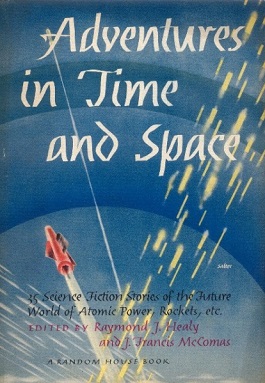
Cover image of science fiction anthology titled Adventures in Time and Space, edited by Raymond J Healy and J Francis McComas.I've so often seen it referred to as "the best" science fiction anthology out there that I had to look it up. A closer look suggests it's mostly selections from Astounding issues edited by John W Campbell, Jr. But good stories. A few points:
  1. It's editor, McComas, is one of the founding editors of F&SF (along with Anthony Boucher).
  2. These selections include 2 stories of Harry Bates. He was the founding editor of Astounding (now called Analog). All Astounding issues he edited are now online.
I 'm dropping non-fiction from the ToC list below; keeping only fiction. Where I'm aware of online versions of stories, I include the links. My rating is in brackets. Link on story title goes to my post on the story, if there is one. Links on nouns yield more matching fiction.

Table of contents (33 stories, best first, unread last).

  1. [novelette] Henry Kuttner and C L Moore's "The Twonky" (as by Lewis Padgett) (A); download; Astounding, September 1942: An audio player that can do your dishes, read & change your mind, stop you from doing naughty things, ...!
  2. [novelette] Henry Kuttner & C L Moore's "The Proud Robot" (as by Lewis Padgett) (A); download; Astounding, October 1943; humor: Hilarious story about a robot in love with itself. Touches on some contemporary themes - video use in a way that annoys content owners, DRM (yes - in a 1943 story!), frivolous patents - but in a manner technologically irrelevant to current times (except last issue - patents).
  3. [novelette] Eric Frank Russell & Maurice G Hugi's "Mechanical Mice" (A); Astounding, January 1941: Robots programmed for survival terrorize a neighborhood.
  4. [novella] John W Campbell, Jr's "Who Goes There?" (as by Don A Stuart) (A); download text, or whole Astounding/August 1938 issue scans, or (in US only) watch John Carpenter's movie adaptation titled "The Thing" (1982) at SF Signal or at Hulu; Astounding, August 1938: Curious figuratively & inadvertently open the bottle to let the djinn out, & all hell breaks loose.
  5. [novelette] John W Campbell, Jr's "Forgetfulness" (as by Don A Stuart) (A); Astounding, June 1937: "it is possible that a type of civilization exists so radically divergent from our own that it is to us unrecognizable as civilization."
  6. [novelette] Raymond Z Gallun's "Seeds of the Dusk" (A); Astounding, June 1938: How Martians exterminated the descendants of humanity...
  7. [novelette] A E van Vogt's "Black Destroyer" (A); Astounding, July 1939; download: A practically immortal super-being of an alien world is attacking human visitors & threatens to overrun inhabited galaxy. I found the ending incomprehensible, but it was an interesting read.

    First published story of Van Vogt.

    "Golden Age" is said to have began with publication of this story!
  8. [novelette] Robert A Heinlein's "The Roads Must Roll" (A); download text as part of a larger package, or MP3 of radio adaptation; Astounding, June 1940: Terrorist attack on suburban transport system causes much mayhem. Transport system itself is of rolling tracks rather than moving vehicles - kind of large scale adaptation of the things seen at some airports.
  9. [novelette] Isaac Asimov's "Nightfall" (A); download MP3; Astounding, September 1941: On a world with many suns, natives are unexposed to the idea of night & are very afraid of dark are about to face night & nightmares due to eclipse that occurs only once several thousand years.

    I personally prefer the corresponding part of its novelization (later half of novel is uninteresting post-apocalypse stuff). I would have ranked this novel part higher in this list.
  10. [ss] Alfred Bester's "Adam and No Eve" (A); download graphic adaptation; Astounding, September 1941: A maniacal inventor inadvertently uses a new discovery & ends up destroying all life on earth. But there is a way yet for earth to rebuild life - only there won't be any more humans.
  11. [ss] Ross Rocklynne's "Quietus" (A); download; Astounding, September 1940: "who we are creates a bias in how we view the world".
  12. [novelette] L Sprague de Camp's "The Blue Giraffe" (A); Astounding, August 1939; humor: When a man was bestowed the honored of marrying an uplifted female baboon!!
  13. [novelette] Harry Bates' "Farewell to the Master" (A); download; Astounding, October 1940; first contact: What we see depends on what we are...

    What makes this story special is its punchline. Early parts of the story are good, but they're not why it's so famous.
  14. [novella] Henry Hasse's "He Who Shrank" (A); Amazing Stories, August 1936: Adventure, interacting with many kinds of alien people. One of the descendants of Jonathan Swift's "Gulliver's Travels".
  15. [novelette] Fredric Brown's "The Star Mouse" (A); Planet Stories, Spring 1942: When "Mitkey" mouse represented earth during first contact with aliens!
  16. [novella] Lester del Rey's "Nerves" (A); Astounding, September 1942: Containing damage in the aftermath of an accident at a facility manufacturing radioactive products.
  17. [novelette] Eric Frank Russell's "Symbiotica" (B); Astounding, October 1943: Travails of inadvertently nasty human adventurers on an alien planet where animal & plant life-forms live in a much closer symbiosis than on earth, & where plants can be very nasty once provoked.
  18. [ss] Robert A Heinlein's "Requiem" (B); Astounding, January 1940: A man dies pursuing a dream. This is a sequel to Heinlein's fantastic "The Man Who Sold the Moon".
  19. [novelette] A E van Vogt's "The Weapon Shop" aka "The Weapons Shop" aka "The Weapon Shops of Isher" (B); Astounding, December 1942: An organization in the role of Robin Hood in a future dystopia.

    I personally found an earlier version of this story - "See-saw" - a much better read.
  20. [ss] Milton A Rothman's "Heavy Planet" (B) (as by Lee Gregory); download; Astounding, August 1939: A native of a super-high gravity & super-dense atmosphere world has found an invaluable relic of alien origin.
  21. [novella] P Schuyler Miller's "The Sands of Time"; 1937: Not read.
  22. [novelette] Henry Kuttner's "Time Locker" (as by Lewis Padgett); download; Astounding, January 1943: Not read.
  23. [ss] Cleve Cartmill's "The Link"; Astounding, August 1942: Not read.
  24. [novella] Harry Bates' "A Matter of Size"; Astounding, April 1934: Not read.
  25. [ss] P Schuyler Miller's "As Never Was"; Astounding, January 1944: Not read.
  26. [ss] Anthony Boucher's "Q. U. R."; Astounding, March 1943: Not read. I think both it's text & MP3 are online, but I don't have links handy.
  27. [novella] A E van Vogt's "Asylum"; Astounding, May 1942: Not read.
  28. [ss] Robert Moore Williams' "Robot's Return" aka "Robots Return"; 1938: Not read.
  29. [novelette] J Francis McComas' "Flight into Darkness" (as by Webb Marlowe); Astounding, February 1943: Not read.
  30. [ss] R DeWitt Miller's "Within the Pyramid"; Astounding, March 1937: Not read.
  31. [novella] Robert A Heinlein's "By His Bootstraps" (as by Anson MacDonald); Astounding, October 1941: Not read.
  32. [ss] Raymond F Jones' "Correspondence Course"; Astounding, April 1945: Not read.
  33. [ss] S Fowler Wright's "Brain"; 1932: Not read.

Fact sheet.

Alternate title: "Famous Science-Fiction Stories: Adventures in Time and Space".
Credits: Some of the information here comes from ISFDB.
Legend: ss = short story.

Tuesday, February 17, 2009

Free fiction: A E Van Vogt

These are 2 or 3 months old links that were lost in my bookmarks.

Three stories from A E Van Vogt's collection Transgalactic (ed Eric Flint & David Drake) at Webscription:

  1. "A Son is Born"; download; Astounding, May 1946.
  2. "Child of the Gods"; download; Astounding, August 1946.
  3. "Hand of the Gods"; download; Astounding, December 1946.

Saturday, August 16, 2008

Murray Leinster's "A Logic Named Joe" (short story, artificial intelligence, humor, free): Exploits of a super-intelligent but ethics-less AI

---

Fact sheet.

First published: Astounding Science Fiction, March 1946 (as by Will F Jenkins).
Rating: A
Added to the list of stories from Campbell's Astounding.
Download full text, or MP3 audio (dramatized).
Related: All stories of Murray Leinster.
---

I liked this story because it's a fun & light read - sometimes hilarious. But that's not the normally cited reason when I looked up others' posts on the story - it's the technology prophesy (see below) in the story that gets often cited.

Story summary.

It's the story of Joe, a machine with an interface somewhat akin to a modern internet-connected PC. A manufacturing defect has turned Joe into a very competent AI - but one without any sense of human morals or ethics, or of survival.

At some level, there is a similarity with Jack Williamson's "With Folded Hands". Machines in both stories are in service of humanity - though with different motives. Both lead to undesirable results.

Joe is neither malevolent not benevolent. It just wants to stay busy - so it infects every computer on the public network to offer a very useful service to their human users: ask any question, & Joe will answer it!

Chaos reins as Joe begins offering very effective advise on how to murder someone or rob a bank without getting caught, what the bank balance of your neighbor is, design of a device that will brainwash the population of a city to adopt your religion, ...!!

"Ducky", the narrator & "a maintenance man for the Logics Company" who earns his living "servicing logics", will ultimately identify Joe & take it out of system by seeking Joe's own help.

Technology prophesy.

The oft-cited distinguishing feature of this apparently very famous story is: it describes something akin to modern internet-connected PCs. The story was written when neither the word "computer" nor "software" were in widespread use. In fact, the story uses the word "logic" to describe both the computer & the software.

While there is justification for this praise, it foretells future only in the sense of Jules & Michel Verne's "In The Year 2889": wild & intelligent imagination imposed on foreseeable technology.

Computers of this story, where any details are provided, are in fact very outdated; what is up to date is the effect & the way they are used - something where even modern systems have some catching up to do.

You need to tinker with hardware to change programs - like in Arthur Clarke's "The Nine Billion Names of God". While a lot of families have one of these machines at home, they are big clunky things - except for a rather modern viewscreen/keyboard interface (no pointing device or GUI). A big "tank" holds the guts of the system, & "plates" in it store data. If you have physical access to the machine, you can switch the power on/off. When on, it's always connected to the sole big worldwide network - no way of disconnecting it from network, or connecting it to a different network! There is a notion of user identity, but apparently the machines believe you won't lie. "Censor-circuits" built into the machine filter the kind of information it will reveal (ha ha).

These prophesies may be of interest to computing historians. For me, the fun part is reason enough.

Collected in.

  1. Murray Leinster's "A Logic Named Joe" (collection).
  2. "The Best of Murray Leinster" (ed J J Pierce).

Thursday, June 19, 2008

C L Moore's "Daemon" (novelette, fantasy): Precursor to "Flowers for Algernon"?

Quote from short story titled Daemon by C L MooreThere is just too much similarity between this story, & Daniel Keyes' "Flowers for Algernon": half-wit narrator in similar circumstances, similar tone, ... There is even a scene where narrator puts flowers on the grave of his benefactor & friend. I don't know if it directly influenced Mr Keyes, or both were influenced by something older (this story appeared a decade before Keyes').

The differences are:

  1. It's presented as fantasy rather than science fiction.
  2. The world he lives in is far crueler than in Keyes' version; there are occasional gory scenes of violence. Though he gets love too & doesn't quite lose his humanity till end, as in Keyes' version. And dies at end too, like in Keyes' story.
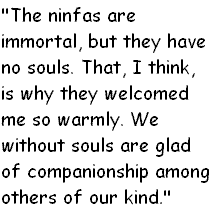
  3. Protagonist never becomes a superman here. Though he has something superhuman that others don't; at least he says so, though we never know if it's his fanciful imagination doing the talking: "I could see things such as other men do not know... Do you know who stands beside you, padre, listening while I talk? ... I have always known the things that walk beside men - other men. Not me. Perhaps they are souls, & I have no soul, being simple. Or perhaps they are daemons such as only clever men have. Or perhaps they are both these things... most men have shapes that walk behind them... Some of them are dark, like the shapes I saw in the saloon. Some of them are bright, like that which followed my grandmother. Some of them are colored".
Very moving story. Very beautifully told.

Story has a lot of references to European lore & legends. Familiarity with them will likely make you enjoy the story even more than I did.

Story summary.

Entire story is narrated by the half-wit protagonist, "Luiz o Bobo, which is to say, Luiz the Simple", on his death bed to a padre.

Rio de Janeiro, Brazil, is his city. Lost after the death of his grandma ("Minha avó") who'd raised him, he somehow lived off the streets. When one fine day, he's kidnapped by a band of sailors at the port - to serve as slave labor on their ship ("Dancing Martha"). He awakens aboard ship, & is repeatedly & badly beaten up on trivialest issues or just for pleasure of the monster of the "Yankee" Captain, Jonah Stryker - couple of short but gory scenes of violence here.

But he finds love in an old & rich Irishman, Shaughnessy - a passenger on the ship. Ship is Ireland bound after a couple of stops in Americas, but there is a problem on the way - "the drinking water became foul" & needed to be replaced. So they berth at a tiny unnamed uninhabited island somewhere in the Atlantic.

Shortly before landing, Luiz gets severe beating & major head injury at the hands of Captain - simply because Captain is irritated. While others are busy replenishing water, badly injured Luiz will fall off the ship when trying to jump off, & will be washed ashore a beach on the island. Shaughnessy will go looking for him, & will care for him after finding him unconscious. Meanwhile, Captain leaves these two stranded, & heads for his destination.

This is where we see Luiz come into his own. Even get a bit smarter. Old man is dying, & will teach Luiz the basic life skills. Eventually, the old man will die. He'd already told Luiz the burial technique & handed him a cross with a message engraved for whoever comes looking for him. Luiz will do the needful, & grieve in his own way.

Now alone on island, Luiz, with his great imagination, finds the island inhabited with many kinds of magical creatures - "oread", "unicorn", "the One" aka "the Master" aka "Great Pan" aka "Piper" with "his goat-hoofed foot", "ninfas ... And the others." Life is going well for him when the ship Dancing Martha & evil Captain Stryker return.

Realizing that any story handed out to relatives of Shaughnessy will not be believed, Captain has returned part-way through voyage to kill the two he left stranded. He lands on island alone, leaving crew aboard the ship anchored nearby. He finds Shaughnessy's grave, & burns the cross with engraved message.

Substantial part of later story is devoted to Captain's hunt of Luiz around the island. And escape of Luiz's magical friends; they cannot share an island with an evil soul. End is the death of both - Luiz by a gunshot fired by Captain, Captain by a hand attack by an injured Luiz.

Collected in.

  1. "The Best of C L Moore".

Fact sheet.

First published: Famous Fantastic Mysteries, October 1946.
Rating: A

Thursday, April 24, 2008

Henry Kuttner & C L Moore's "Vintage Season" (as by Lawrence O'Donnell) (novella, science fiction): On a dark side of human nature

Quote from short story titled Vintage Season by Henry Kuttner and C L Moore, writing as Lawrence O DonnellNote the author is a pseudonym of Henry Kuttner & C L Moore couple.
Amazing thing about this story is it makes such a light read while addressing a very dark subject. All the dark issues are brought up near end; most of the story simply builds anticipation & develops characters.

Story is set at a time that is 1,000 years after "Charlemagne's coronation at St Peter's on Christmas Day". I've no idea of what date that would be.

Story summary.

Oliver Wilson owns a "time-worn old house" that he has leased out for a month to holidayers. In May. Month seems to have a significance - but I didn't quite get it apart from "there never was a May like it in civilized times". The house also has servants who go home after serving dinner (I wonder if that says something about the period in which the story is set).

After he signed lease documents, he received a very very lucrative offer for sale - provided he sells before May end. Buyer is not interested in buying afterwards. His fiancee, Sue Johnson, has been nagging him to accept the offer, but he cannot find a way out of earlier lease.

On appointed day, the original tenants arrive. Sanciscos, three of them - a man named Omerie, & two women named Klia, & Kleph. They want him to get out of the place during lease period; he refuses - planning to make a nuisance of himself to force them out. He won't succeed.

Through the story, there is a certain mystery associated with the visitors. They refuse to tell where they come from, but they have amazing gadgets.

During climax, we will learn that they are time travelers from far future - where you have ample leisure. They are on an year long vacation - at different places & times, "a tour of a year's seasons. Vintage seasons."

A few days before the end of may, we see the other bidder try some underhand tricks to kick the current tenants out - without success. On the final day of the climax - we are not told if this is last day of May - the tenants receive a lot of guests. Turns out there are a lot of time travelers enjoying this May here.

Sometime in the night, the disaster hits. A meteor has hit somewhere close by, pretty much leveling the city. Everything is in chaos. But this house is left untouched.

Turns out, these visitors from future came to watch the spectacle! They not only knew about the disaster (& that this house will survive), but could have prevented it. But they are looking at people so far back in time, they don't feel any bond; visitors are we, locals are they. And besides, may be the intervention here will affect their cozy future - though no one has attempted to even find out.

In between, we also have a short romance between Oliver & Kleph. While most time travelers will promptly leave after watching the spectacle, one future artist - Cenbe - will remain. He will watch the aftermath; then go back to his time & present his composition to great applause.

In a final sad thread, Oliver makes a written note about the incident for any future time travelers that might have some pity. He has not yet figured out how to deliver it to them, when local administration will dynamite his home - along with his note & presumably him - "part of the futile attempt to halt the relentless spread of the Blue Death." "Blue Death" is apparently a deadly disease triggered by this meteor impact.

Notes.

Among the many gadgets that the story talks of, 2 have remained with me:
  1. A tiny machine that produces "subsonics" that drives human listeners crazy. This idea also appears in another Kuttner/Moore story, "The Proud Robot".
  2. Tea cups that heat their contents as necessary.

See also.

  1. Rahul Jaisheel's "21 Minutes" is a less drastic variant of this story.
  2. According to IMDB, 1992 movie "Timescape", directed by David Twohy, is an adaptation of this story.

Collected in.

  1. Ben Bova (Ed)'s "The Science Fiction Hall of Fame, Volume Two A".
  2. "The Best of C L Moore".

Fact sheet.

First published: Astounding Science Fiction, September 1946.
Rating: A
Listed among the stories from John Campbell's Astounding/Analog.
Related: Stories of Henry Kuttner, C L Moore, as by Lawrence O'Donnell.

Sunday, March 9, 2008

Henry Kuttner's "Absalom" (short story, non-genre): Generation gap can be a major source of parents' heartache

Quote from short story titled Absalom by Henry KuttnerThis is the second story I've seen from Kuttner on the theme of generation gap. But this is a much darker story compared to "Mimsy Were the Borogoves".

An overprotective father cannot understand his son's ambitions. And both parties are willing to hurt each other.

While there is a small science fictional element, I think this story is best classified as non-genre.

Title is the name of some character from Bible: "Absalom sent spies throughout all the tribes of Israel, saying, As soon as ye hear the sound of the trumpet, then ye shall say, Absalom reigneth in Hebron". Presumably there is a similarity in theme. I'm not familiar with Bible - so cannot comment on this aspect.

Free SF Reader notes this audio rendition of Absalom (MP3 file). I personally haven't heard this audio version.

Story summary.

Joel Locke holds "the chair of psychonamics" at "the university". Other members of his household are housekeeper Abigail Schuler, & his son Absalom.

For the last few generations, a genetic mutation has been sweeping through the population, turning "homo sapiens to homo superior" - making larger parts of the younger generation much smarter than their elders. Absalom is an 8 year old prodigy - far smarter than his father.

Absalom wants to go to university at Baja California or to Crèche, where other lads of his caliber are in abundance, & study "entropic logic". Overprotective dad won't allow this. Somewhere at the back of dad's head is also the fact that he himself cannot understand entropic logic - so the subject must be beyond the son too.

To enforce his will, the father has been using a process called "rapport" over the years with Absalom. It's a way "in which it was possible to enforce hypnosis, to pry open a mind willy nilly and search it for contraband thoughts." Dad will soon discover the child has grown beyond even what this insidious technique can achieve.

In the end, we see an angry father about to physical hit the son; housekeeper hits the dad to protect the son - throwing him unconscious. Son uses this opportunity to tinker with his dad's brain with help from his friend over phone.

Father is not externally hurt, & can do his daily chores; but he can no longer think of opposing the son's ambitions, keeps eagerly waiting for son to call when he's gone to university, & is constantly aware he is forced into this by son's tinkering & thus hates the son. Story ends with dad's wish for revenge: "Some day Absalom would have a son."

Quotes.

  1. "Something had begun to stir lazily far back in the brains of the coming generations and a new species, of a sort, was coming slowly into being."
  2. "You've the advantage of knowing yourself better than I could know you. You're handicapped by immaturity, lack of a sense of proportion. And I've had the advantage of more experience."

    "Your own, though, Dad. How much would such values apply to me?"
  3. "Don't forget that legally I exercise control over you, though I'll never do that without your agreement that I'm acting justly."

    "Justice for you may not be justice for me".
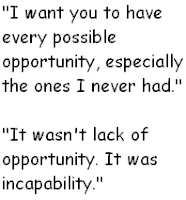
  4. "I want you to have every possible opportunity, especially the ones I never had."

    "It wasn't lack of opportunity. It was incapability."
  5. "You're afraid that I'll outstrip you. And I will."
  6. "it's the role of any parent to protect its young. Only the immature parents are out of step - like you."

See also.

  1. Wilmar H Shiras' "In Hiding": Another story where genetic mutation has created a very gifted child, but his grandmother is forcing him to behave at the level of his peers. But Shiras' story is much less dark.

Collected in.

  1. "The Best of Henry Kuttner"

Fact sheet.

"Absalom", short story, review
First published: Startling Stories, Fall 1946.
Rating: A
All stories by Henry Kuttner.